


Page 56 - Hub-4 Magazine Issue 78
P. 56
  Quarrying News
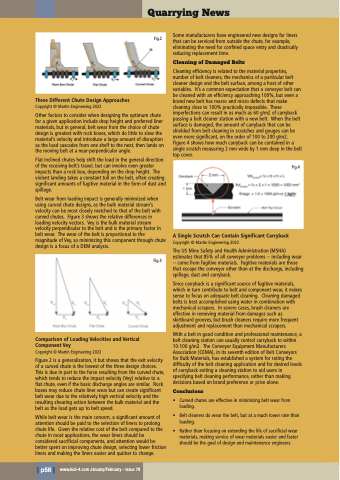
Other factors to consider when designing the optimum chute for a given application include drop height and preferred liner materials, but in general, belt wear from the choice of chute design is greatest with rock boxes, which do little to slow the material’s velocity and introduce a large amount of disruption as the load cascades from one shelf to the next, then lands on the moving belt at a near-perpendicular angle.
Flat inclined chutes help shift the load in the general direction of the receiving belt’s travel, but can involve even greater impacts than a rock box, depending on the drop height. The violent landing takes a constant toll on the belt, often creating significant amounts of fugitive material in the form of dust and spillage.
Belt wear from loading impact is generally minimized when using curved chute designs, as the bulk material stream’s velocity can be most closely matched to that of the belt with curved chutes. Figure 3 shows the relative differences in loading velocity vectors. Vey is the bulk material stream velocity perpendicular to the belt and is the primary factor in belt wear. The wear of the belt is proportional to the magnitude of Vey, so minimizing this component through chute design is a focus of a DEM analysis.
Fig.3
Comparison of Loading Velocities and Vertical Component Vey
Copyright © Martin Engineering 2022
Figure 2 is a generalization, it but shows that the exit velocity of a curved chute is the lowest of the three design choices. This is due in part to the force resulting from the curved chute, which tends to reduce the impact velocity (Vey) relative to a flat chute, even if the basic discharge angles are similar. Rock boxes may reduce chute liner wear but can create significant belt wear due to the relatively high vertical velocity and the resulting shearing action between the bulk material and the belt as the load gets up to belt speed.
While belt wear is the main concern, a significant amount of attention should be paid to the selection of liners to prolong chute life. Given the relative cost of the belt compared to the chute in most applications, the wear liners should be considered sacrificial components, and attention would be better spent on improving chute design, selecting lower friction liners and making the liners easier and quicker to change.
A Single Scratch Can Contain Significant Carryback
Copyright © Martin Engineering 2022
Fig.2
Some manufacturers have engineered new designs for liners that can be serviced from outside the chute, for example, eliminating the need for confined space entry and drastically reducing replacement time.
Cleaning of Damaged Belts
Cleaning efficiency is related to the material properties, number of belt cleaners, the mechanics of a particular belt cleaner design and the belt surface, among a host of other variables. It’s a common expectation that a conveyor belt can be cleaned with an efficiency approaching 100%, but even a brand new belt has macro and micro defects that make cleaning close to 100% practically impossible. These imperfections can result in as much as 60 g/m2 of carryback passing a belt cleaner station with a new belt. When the belt surface is damaged, the amount of carryback that can be shielded from belt cleaning in scratches and gouges can be even more significant, on the order of 100 to 200 g/m2. Figure 4 shows how much carryback can be contained in a single scratch measuring 2 mm wide by 1 mm deep in the belt top cover.
Fig.4
The US Mine Safety and Health Administration (MSHA) estimates that 85% of all conveyor problems -- including wear -- come from fugitive materials. Fugitive materials are those that escape the conveyor other than at the discharge, including spillage, dust and carryback.
Since carryback is a significant source of fugitive materials, which in turn contribute to belt and component wear, it makes sense to focus on adequate belt cleaning. Cleaning damaged belts is best accomplished using water in combination with mechanical scrapers. In severe cases, brush cleaners are effective in removing material from damages such as skirtboard grooves, but brush cleaners require more frequent adjustment and replacement than mechanical scrapers.
With a belt in good condition and professional maintenance, a belt cleaning station can usually control carryback to within 10-100 g/m2. The Conveyor Equipment Manufacturers Association (CEMA), in its seventh edition of Belt Conveyors for Bulk Materials, has established a system for rating the difficulty of the belt cleaning application and for desired levels of carryback exiting a cleaning station to aid users in specifying belt cleaning performance, rather than making decisions based on brand preference or price alone.
Conclusions
• Curved chutes are effective in minimizing belt wear from loading.
• Belt cleaners do wear the belt, but at a much lower rate than loading.
• Rather than focusing on extending the life of sacrificial wear materials, making service of wear materials easier and faster should be the goal of design and maintenance engineers.
 Three Different Chute Design Approaches
Copyright © Martin Engineering 2022
   | p56 |
www.hub-4.com January/February - Issue 78


