


Page 45 - HUB-4 Magazine Issue 95
P. 45
Quarrying
Particulates matter:
Controlling Dust at Transfer Points
Todd Swinderman, CEO Emeritus / Martin Engineering
Understanding material flow is vital to
controlling fugitive dust to reduce health risks,
environmental issues, expensive clean-ups and
unplanned downtime. Addressing the root
causes may be simpler than you think, writes
Todd Swinderman of Martin Engineering.
The root causes of fugitive dust at transfer points are usually
obvious but rarely addressed. The common approach to
dealing with spillage, leakage and carryback seems to be to
treat the symptoms with guesswork. Yet fixing these issues
with workable, long-term solutions is proven to increase
uptime, reduce costs, improve housekeeping, and ultimately
boost profitability.
There are many traditional ‘rules of thumb’ for calculating
skirtboard sizing and dust curtain placement in an attempt to
contain the dust in the enclosure. Decades of field experience
suggests most of these practices are without proof of
performance.
Nevertheless, current practice for conveyor skirtboard
enclosures is to design for Vair ≤ 1.0 m/s by increasing the
height of the enclosure. A common approach is for the
enclosure length to be twice the belt width or 0.6 m for every
1.0 m/s in belt speed. If the enclosure height (H) is increased,
the distance (L) that ‘average’ dust particles travel also
increases. Modeling Air Flow
To examine this practice, detailed design studies of air flow
and particulate settling were performed by Martin Engineering
using flow simulation software. A complete ‘typical’ conveyor
transfer point was carefully modeled with a focus on the flow
of air in the enclosure of the receiving belt, with both external
and internal air flow analysed.
The results of the external analysis indicated that escaped dust
particles increased in speed as the air current is affected by
traveling around the belt and the discharge pulley. [See Figure
2.] This phenomenon is known as the Magnus Effect and
emphasizes the need for effective belt cleaning as close to any
discharge as possible.
Modern skirtboard designs allow for double skirting that flex with
the belt for a better seal.
Reducing visible nuisance dust emissions from conveyors is
perhaps understandably a primary goal for operators. Yet it’s
the respirable dust that can’t be seen by the naked eye that’s
more likely to be responsible for longer-term health issues.
In enclosed operations, the use of respirators is sometimes
seen as an acceptable alternative, but PPE should always be a
last resort. And besides, respirators themselves can actually
reduce productivity, so a more sophisticated root-cause
approach to containing dust must be taken.
Settling at Transfer Points
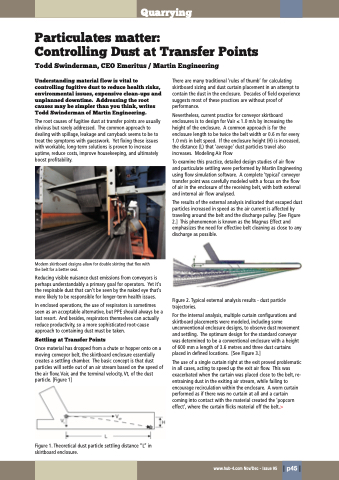
Once material has dropped from a chute or hopper onto on a
moving conveyor belt, the skirtboard enclosure essentially
creates a settling chamber. The basic concept is that dust
particles will settle out of an air stream based on the speed of
the air flow, Vair, and the terminal velocity, Vt, of the dust
particle. [Figure 1]
Figure 2. Typical external analysis results - dust particle
trajectories.
For the internal analysis, multiple curtain configurations and
skirtboard placements were modeled, including some
unconventional enclosure designs, to observe dust movement
and settling. The optimum design for the standard conveyor
was determined to be a conventional enclosure with a height
of 600 mm a length of 3.6 metres and three dust curtains
placed in defined locations. [See Figure 3.]
The use of a single curtain right at the exit proved problematic
in all cases, acting to speed up the exit air flow. This was
exacerbated when the curtain was placed close to the belt, re-
entraining dust in the exiting air stream, while failing to
encourage recirculation within the enclosure. A worn curtain
performed as if there was no curtain at all and a curtain
coming into contact with the material created the ‘popcorn
effect’, where the curtain flicks material off the belt.>
Figure 1. Theoretical dust particle settling distance “L” in
skirtboard enclosure.
www.hub-4.com Nov/Dec - Issue 95
| p45 |


