


Page 39 - HUB-4 Magazine Issue 99
P. 39
Concrete
These clearly defined routes help reduce uncertainty and
reinforce site rules, particularly for contractors and visitors
who may be unfamiliar with the quarry layout.
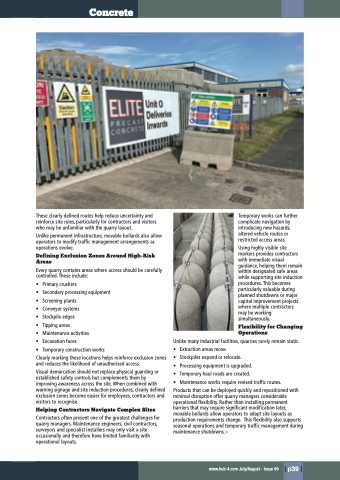
Unlike permanent infrastructure, movable bollards also allow
operators to modify traffic management arrangements as
operations evolve.
Defining Exclusion Zones Around High-Risk
Areas
Every quarry contains areas where access should be carefully
controlled. These include:
• Primary crushers
• Secondary processing equipment
• Screening plants
• Conveyor systems
• Stockpile edges
• Tipping areas
• Maintenance activities
• Excavation faces
• Temporary construction works
Clearly marking these locations helps reinforce exclusion zones
and reduces the likelihood of unauthorised access.
Visual demarcation should not replace physical guarding or
established safety controls but complements them by
improving awareness across the site. When combined with
warning signage and site induction procedures, clearly defined
exclusion zones become easier for employees, contractors and
visitors to recognise.
Helping Contractors Navigate Complex Sites
Contractors often present one of the greatest challenges for
quarry managers. Maintenance engineers, civil contractors,
surveyors and specialist installers may only visit a site
occasionally and therefore have limited familiarity with
operational layouts.
Temporary works can further
complicate navigation by
introducing new hazards,
altered vehicle routes or
restricted access areas.
Using highly visible site
markers provides contractors
with immediate visual
guidance, helping them remain
within designated safe areas
while supporting site induction
procedures. This becomes
particularly valuable during
planned shutdowns or major
capital improvement projects
where multiple contractors
may be working
simultaneously.
Flexibility for Changing
Operations
Unlike many industrial facilities, quarries rarely remain static.
• Extraction areas move.
• Stockpiles expand or relocate.
• Processing equipment is upgraded.
• Temporary haul roads are created.
• Maintenance works require revised traffic routes.
Products that can be deployed quickly and repositioned with
minimal disruption offer quarry managers considerable
operational flexibility. Rather than installing permanent
barriers that may require significant modification later,
movable bollards allow operators to adapt site layouts as
production requirements change. This flexibility also supports
seasonal operations and temporary traffic management during
maintenance shutdowns.>
www.hub-4.com July/August - Issue 99
| p39 |


