


Page 21 - HUB-4 Magazine Issue 100
P. 21
Material Recycling Facilities
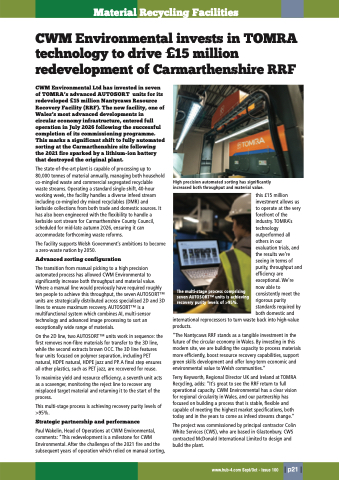
High precision automated sorting has significantly
increased both throughput and material value.
CWM Environmental invests in TOMRA
technology to drive £15 million
redevelopment of Carmarthenshire RRF
CWM Environmental Ltd has invested in seven
of TOMRA’s advanced AUTOSORT units for its
redeveloped £15 million Nantycaws Resource
Recovery Facility (RRF). The new facility, one of
Wales’s most advanced developments in
circular economy infrastructure, entered full
operation in July 2026 following the successful
completion of its commissioning programme.
This marks a significant shift to fully automated
sorting at the Carmarthenshire site following
the 2021 fire sparked by a lithium-ion battery
that destroyed the original plant.
The state-of-the-art plant is capable of processing up to
80,000 tonnes of material annually, managing both household
co-mingled waste and commercial segregated recyclable
waste streams. Operating a standard single-shift, 40-hour
working week, the facility handles a diverse infeed stream
including co-mingled dry mixed recyclables (DMR) and
kerbside collections from both trade and domestic sources. It
has also been engineered with the flexibility to handle a
kerbside sort stream for Carmarthenshire County Council,
scheduled for mid-late autumn 2026, ensuring it can
accommodate forthcoming waste reforms.
The facility supports Welsh Government’s ambitions to become
a zero-waste nation by 2050.
Advanced sorting configuration
The transition from manual picking to a high precision
automated process has allowed CWM Environmental to
significantly increase both throughput and material value.
Where a manual line would previously have required roughly
ten people to achieve this throughput, the seven AUTOSORT™
units are strategically distributed across specialised 2D and 3D
lines to ensure maximum recovery. AUTOSORT™ is a
multifunctional system which combines AI, multi-sensor
technology and advanced image processing to sort an
exceptionally wide range of materials.
On the 2D line, two AUTOSORT™ units work in sequence: the
first removes non-fibre materials for transfer to the 3D line,
while the second extracts brown OCC. The 3D line features
four units focused on polymer separation, including PET
natural, HDPE natural, HDPE jazz and PP. A final step ensures
all other plastics, such as PET jazz, are recovered for reuse.
To maximise yield and resource efficiency, a seventh unit acts
as a scavenger, monitoring the reject line to recover any
misplaced target material and returning it to the start of the
process.
This multi-stage process is achieving recovery purity levels of
>95%.
Strategic partnership and performance
Paul Wakelin, Head of Operations at CWM Environmental,
comments: “This redevelopment is a milestone for CWM
Environmental. After the challenges of the 2021 fire and the
subsequent years of operation which relied on manual sorting,
The multi-stage process comprising
seven AUTOSORT™ units is achieving
recovery purity levels of >95%.
this £15 million
investment allows us
to operate at the very
forefront of the
industry. TOMRA’s
technology
outperformed all
others in our
evaluation trials, and
the results we’re
seeing in terms of
purity, throughput and
efficiency are
exceptional. We’re
now able to
consistently meet the
rigorous purity
standards required by
both domestic and
international reprocessors to turn waste back into high-value
products.
“The Nantycaws RRF stands as a tangible investment in the
future of the circular economy in Wales. By investing in this
modern site, we are building the capacity to process materials
more efficiently, boost resource recovery capabilities, support
green skills development and offer long-term economic and
environmental value to Welsh communities.”
Terry Keyworth, Regional Director UK and Ireland at TOMRA
Recycling, adds: “It’s great to see the RRF return to full
operational capacity. CWM Environmental has a clear vision
for regional circularity in Wales, and our partnership has
focused on building a process that is stable, flexible and
capable of meeting the highest market specifications, both
today and in the years to come as infeed streams change.”
The project was commissioned by principal contractor Colin
White Services (CWS), who are based in Glastonbury. CWS
contracted McDonald International Limited to design and
build the plant.
www.hub-4.com Sept/Oct - Issue 100
| p21 |

