


Page 4 - HUB-4 Magazine Issue 100
P. 4
Feature story
The issue was not only environmental but financial. The
company was spending between £300,000 and £350,000 each
year on haulage costs associated with the disposal of skip
fines. At the same time, potential changes to landfill taxation
created uncertainty around future operating costs. With
increasing pressure to improve recovery rates and reduce
dependency on landfill, Stuart Partners recognised that a new
solution was required.
After several months researching available technologies, Troy
Stuart began discussions with Parnaby Cyclones in July 2025.
During the evaluation process, Parnaby demonstrated the
capabilities of its Natural Medium Barrel Plant, designed
specifically to treat complex waste streams that many
conventional systems struggle to process efficiently.
What immediately stood out to the Stuart team was the
plant's straightforward yet highly robust design. The Natural
Medium Barrel's resistance to material entanglement,
combined with its unique dynamic density separation process,
offered a practical solution for handling waste streams
containing a broad range of contaminants. Unlike many
alternatives on the market, the system is not constrained by
floats capacity, allowing operators greater flexibility when
processing materials with high organic and plastic content.
The relationship between the two companies quickly
developed beyond that of a traditional supplier and customer.
As family-run businesses, both organisations shared similar
values, with direct communication playing a central role
throughout the project. From the earliest stages, Troy Stuart
and his sons, Tom and Jack, worked closely with Adrian
Parnaby and Ian Parnaby, ensuring the final design was
tailored to the operational requirements of the Stuart Partners
site.
The first stage of the system centres on the Natural Medium
Barrel. Here, density separation is used to divide the material
into distinct fractions. Lightweight contaminants migrate
towards the lower end of the inclined barrel, while heavier
aggregate material is conveyed upwards. Integrated sizing
components also allow material below 4mm to be separated
and directed towards further refinement.
Following the initial separation stage, the material enters
Parnaby's Natural Medium Cyclone System, where further
cleaning of the sand fraction takes place. Using dynamic
forces, the cyclone system effectively separates remaining light
contaminants from the sand, helping to produce a cleaner and
more marketable product.
To maximise efficiency, Parnaby incorporated a Roto-sieve
system to manage the lightweight fraction. Continuous
cleaning of the rotating screening drum helps prevent
blockage and maintains throughput, even when processing
fibrous materials that would quickly blind conventional
screening surfaces.
The third stage focuses on classification and fine sand
recovery. Parnaby's classifying cyclones allow precise
adjustment of particle size distribution while simultaneously
controlling the material entering the effluent treatment
system. This allows Stuart Partners to optimise production
according to market demand.
While material recovery attracts most of the attention in a
washing plant, effective water management is often the key to
long-term performance. Recognising this, Parnaby designed a
comprehensive effluent treatment system as the fourth and
final stage of the process.
The effluent treatment system comprises water conditioning,
solids concentration and solids dewatering. A thickener
concentrates suspended solids while allowing clarified water
to be returned to the washing circuit. The thickener underflow
is then transferred to a buffer tank before progressing to the
dewatering stage.
The filter press is the final part of the
Effluent Treatment System. During the
concept stage of the project Parnaby
provided two options for Troy and
Tom to consider. These being
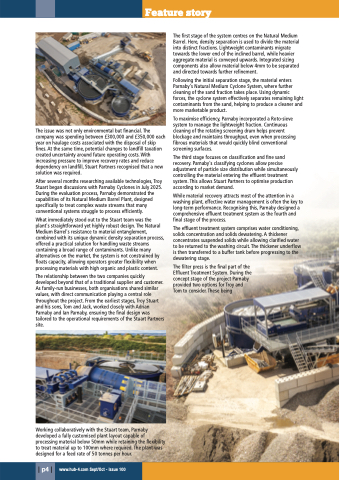
Working collaboratively with the Stuart team, Parnaby
developed a fully customised plant layout capable of
processing material below 50mm while retaining the flexibility
to treat material up to 100mm where required. The plant was
designed for a feed rate of 50 tonnes per hour.
| p4 | www.hub-4.com Sept/Oct - Issue 100


