


Page 44 - HUB-4 Magazine Issue 100
P. 44
Quarrying News
Compaction in Action: Resolving
Bulk Silo Blockages
Mike Moody / Business Development Manager - Air Cannons / Martin Engineering
Clogging issues associated with silo and hopper management
have inspired safety-minded companies to seek efficient and
economical solutions. After facing excessive clogging in its
hoppers, Tilcon Connecticut Inc., a producer of building
materials like crushed stone, hot mix asphalt, and ready-mix
concrete in the Northeastern region of the United States, is
one of those companies.
demands by customers have increased the clogging
occurrences.”
Bulk Powder and Production
Headquartered in New Britain, Connecticut, Tilcon operates
four quarries and three sand/gravel pits in the state. Tilcon’s
two basalt silos were placed side by side, each 40 feet long, 15
feet wide, and 20 feet deep, with a total of 500 tons of
capacity. Fed by conveyors, the bins discharge into haul trucks
and rail cars.
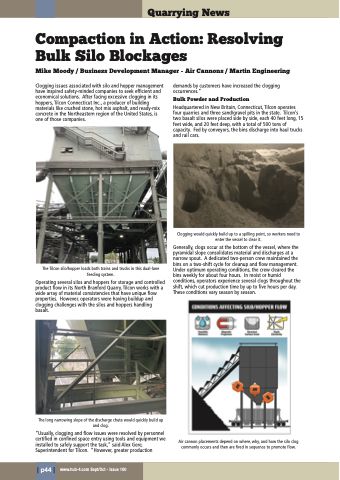
The Tilcon silo/hopper loads both trains and trucks in this dual-lane
feeding system.
Operating several silos and hoppers for storage and controlled
product flow in its North Branford Quarry, Tilcon works with a
wide array of material consistencies that have unique flow
properties. However, operators were having buildup and
clogging challenges with the silos and hoppers handling
basalt.
Clogging would quickly build up to a spilling point, so workers need to
enter the vessel to clear it.
Generally, clogs occur at the bottom of the vessel, where the
pyramidal slope consolidates material and discharges at a
narrow spout. A dedicated two-person crew maintained the
bins on a two-shift cycle for cleanup and flow management.
Under optimum operating conditions, the crew cleared the
bins weekly for about four hours. In moist or humid
conditions, operators experience several clogs throughout the
shift, which cut production time by up to five hours per day.
These conditions vary season by season.
The long narrowing slope of the discharge chute would quickly build up
and clog.
“Usually, clogging and flow issues were resolved by personnel
certified in confined space entry using tools and equipment we
installed to safely support the task,” said Alex Gere,
Superintendent for Tilcon. “However, greater production
Air cannon placements depend on where, why, and how the silo clog
commonly occurs and then are fired in sequence to promote flow.
| p44 |
www.hub-4.com Sept/Oct - Issue 100


