Conveyor Skirtboard design to Control Dust and Spillage


R. Todd Swinderman, P.E. / President Emeritus / Martin Engineering
Whether the belt conveyor transfer chute is a dead drop, rock box design, or sloped design, dust and spillage from dry bulk material must be controlled. Fugitive material can limit access to a system for maintenance, foul rolling components, add to labor costs for cleanup, and reduce workplace safety.
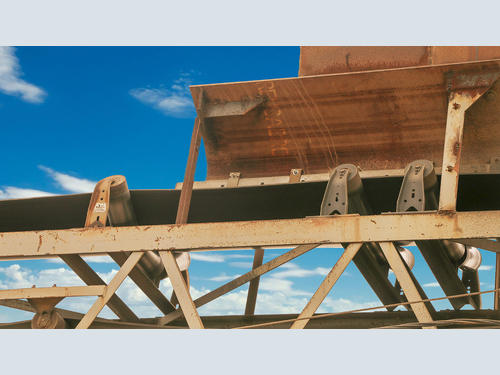
This article covers some of the common approaches to skirtboard configuration that bulk handlers use to mitigate dust and spillage to ensure a safe and compliant workplace with a lower cost of operation. [Fig.1]
Configuring the Skirtboard
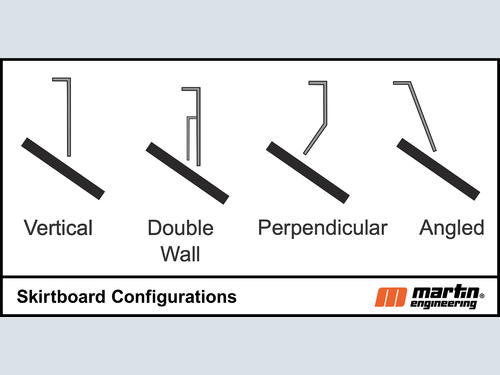
By far the most common configuration is the vertical skirtboard.[Fig. 2] The height of the skirtboard is based on the sealing system components and is commonly at least 300 mm high. The double wall skirtboard is sometimes used with dust extraction for very fine free flowing materials'
The perpendicular and angled configurations are used in some industries. Angled skirtboards are designed to allow the load to center. Perpendicular skirtboards relieve side pressure on the skirtboard seal.
Skirt Sealing Configurations
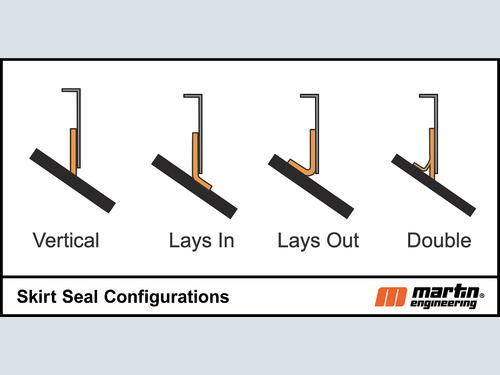
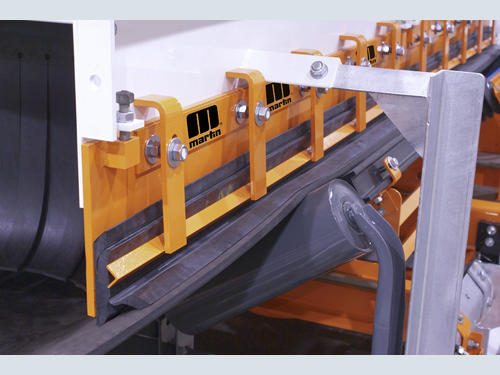
Vertical seal with a rubber or elastomeric material is the most common sealing system. [Fig. 3] The seal is held in place with a series of clamps which can be loosened to adjust the seal against the belt. The main drawback to the vertical seal is that an undulating or vibrating belt can break the sealing contact unless the belt is supported. The lay-in and lay-out seals are self-adjusting depending on the elastic nature of the sealing material. The double skirting configuration is the most effective in retaining a belt seal. Even if the belt profile fluctuates, the secondary seal rides softly on the belt, retaining the seal.
It is a common belief that the seal material must be softer than the belt but the real property of concern is the abrasion resistance of the seal should be less than the belt top cover. The seal is sacrificial and designed for easy adjustment and replacement without excessive sealing pressure.
Over-adjustment can cause excessive friction heat, leading to belt damage and premature skirting wear.
The sealing pressure should be light. For the self-adjusting seals, use 15 kPa contact pressure. CEMA proposes added belt tension of about 4 kN/m per side without considering the seal thickness.
Wearliner Configurations
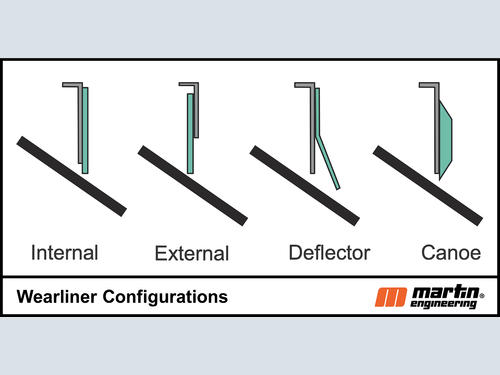
The wearliner has two functions. First is to be a sacrificial wear material protecting the skirtboard wall. The second is to reduce the side pressure on the sealing system. Not all systems require a liner. The most common liner is the internal liner made of abrasion resistant material such as AR plate or ceramic blocks. The liner often has some ability to adjust the space between the bottom and the belt to adjust for wear. [Fig. 4]
The deflector liner is a variation of the internal liner that is used to center the load and reduce side pressure on the seal. The canoe liner performs a similar centering effect with a substantial volume of wear material and is often used in heavy duty applications like hard rock mining.
The most important details for a liner are proper installation and ease of replacement. The external liner was developed to address these two issues. With the external liner, the skirtboard is raised above the expected depth of loaded material causing it to rub against the liner instead of the skirtboard wall. The external design eliminates the gap between the liner and the seal.
Skirtboard Cover Configurations
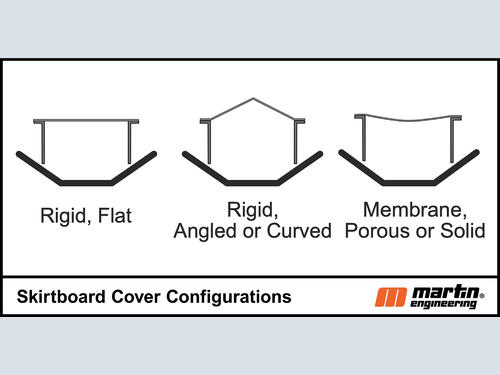
Covers protect the cargo from weather but are used primarily for dust control. Covers enclose the loading zone and contain splashing material caused by significant drop distances from one belt to the other or process equipment such as rotary crushers. The most common cover is the rigid flat cover made from steel. When rain protection or buildup of fugitive materials is a concern, angled or semi-circular covers are often used. [Fig. 5]
Plastic covers are sometimes used to reduce weight. Regardless of the cover design, the most critical design feature is ease of access. When there is a lot of positive pressure in the enclosure, sealing the covers becomes an issue. Porous covers are sometimes used to reduce positive pressure, but the most common membrane applications are rubberized fabric with continuous grip edges that can connect between vibrating equipment, such as screens, and the skirtboard enclosure.
Unfortunately, in the rush to get back into production, covers are removed during cleaning or maintenance and often not replaced in those areas that require frequent access. Maintaining the integrity of the covers is critical to the control of fugitive material. If it is possible that covers will be walked upon, load bearing work platforms should be incorporated into the design.
Skirtboard Design and Installation
The distance the bottom edge of the skirtboard or wearliner from the belt surface often varies by industry. Some designers keep the skirtboard high off the belt to facilitate idler changes but a better solution is to use retractable idlers. The primary issue is the flatness of the belt in the loading area. To achieve a good seal without damaging the belt’s surface, the belt must be supported.
Common practice is to place the wearliner bottom edge parallel, but close to the belt, with approximately 25 mm of clearance for the skirtboard upright from the belt. The liner is then adjusted to be closer to the belt in the range of 10 to 20 mm and self-relieving in the direction of travel. Adjusting the liner to ensure that there are no gaps between liner sections is essential to prevent particles from being trapped and abrading the belt.
Conclusion
Each approach is unique to the application and the bulk handling environment, but preventing dust and spillage makes the cost of the modifications easy to justify over the long run. Consider installing an enclosed modular loading chute with an external wear liner and double skirting. The modular design makes the chute able to be easily adjusted to changes in production, belt speed, or material and the seal and wear liner are adaptable to those changes. This lowers the cost of future modifications and improves the safety of the transfer point throughout the conveyor’s life.