Downturn “far from over” despite rise in materials sales and “missed opportunity” Budget
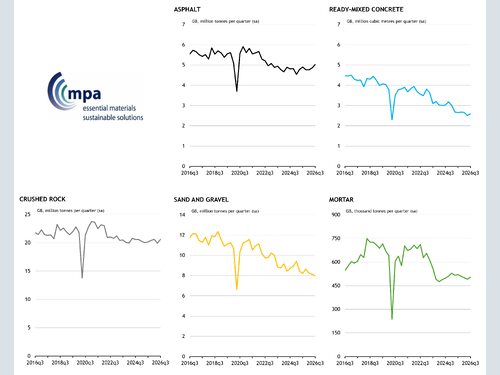


- Sales volumes of aggregates, concrete, asphalt and mortar rose slightly in Q3 2026, from a very low base – the first overall improvement in two years
- Housing and wider construction demand to remain weak well into 2027
- Autumn Budget 2026 seen as missed opportunity for growth, with little near-term boost for British construction
Demand for key construction materials recorded a modest and unexpected improvement in the third quarter of 2026, according to the latest figures from the Mineral Products Association (MPA).
The increase in Q3 sales volumes of aggregates, concrete, asphalt and mortar follows a four-year decline to historically low levels, with persistent weakness in housebuilding and other private sector construction continuing to drag on demand – leading to mothballing of production sites across the country.
Compared with the previous quarter (Q2 2026), seasonally adjusted sales volumes of ready-mixed concrete for Q3 increased by 3.5%, mortar by 2.6%, asphalt by 3.5% and primary aggregates (crushed rock, sand and gravel) by 1.8%. This marked the first broad-based quarterly improvement since late 2024, when hopes of recovery were dashed by Building Safety Regulator followed by the Iran conflict and rising interest rates. The cumulative impact was a double-dip downturn in housebuilding and the lowest concrete volume sales since 1963.
Looking ahead to 2027, persistent housing affordability pressures, rising construction and financing costs, and subdued investor confidence continue to significantly constrain major housing, commercial and industrial investment.
Paul Adeleke, Chief Executive of the MPA, said: "The prolonged construction downturn is far from over, and it’s taking a heavy toll on a sovereign industry that’s essential to delivering the homes, infrastructure and economic growth the country needs. After years of falling demand and mounting costs, domestic producers have already cut jobs and capacity, and shelved investment plans. The damage to our industrial base is real and growing.
"The Autumn Budget was another missed opportunity to put construction and economic growth back on track. It offered little to restore business confidence, tackle the relentless rise in operating costs, or provide certainty over future infrastructure investment. Instead, producers face further cost increases and the prospect of more delays to major projects. The Government cannot keep asking industry to build for the future while allowing the domestic capacity needed to deliver it to be steadily eroded.”
Despite the recent improvement, the underlying weakness remains particularly acute for products most exposed to housebuilding and other private sector construction. Ready-mixed concrete sales, with just under half of Britain’s demand linked to housebuilding, commercial and industrial development, fell by 7.1% in the first nine months of 2026 compared with a year earlier. Mortar sales, primarily driven by housebuilding, declined by 4.5% over the same period. Volumes in these two markets remain 27% and 29% respectively below their levels four years ago, when the Liz Truss Government’s mini-Budget caused turmoil in financial markets and triggered a sharp rise in mortgage rates.
By contrast, infrastructure investment and stronger local road maintenance activity have supported asphalt and crushed rock sales in 2026, both up by 2.6% and 2.2% respectively compared with Q3 last year. Major projects, including Sizewell C, highways improvements and water infrastructure, have helped sustain demand in some regions, although volumes on HS2 work have slowed. However, here again, rising construction costs – including bitumen used in asphalt – are limiting the volume of work that can be achieved under fixed budgets, notably for road building.
Data at national level also mask significant regional differences during Q3 2026. London and the South East, which together account for almost 30% of ready-mixed concrete sales, remain particularly weak, with sales down by 21.4% and 12.6% respectively over the first nine months of 2026. In contrast, the East of England has benefited from progress on major energy, highways and water infrastructure projects, while Scotland has recorded stronger growth with support from large electrical transmission schemes.
The Autumn Budget offers little immediate relief for a construction supply chain already facing five years of declining demand. While the new Your First Home scheme is a welcome step to support housing demand, the OBR expects only a marginal impact on housing supply, with high mortgage rates and rising construction costs continuing to undermine affordability and the viability of new sites. Meanwhile, uncertainty over future public capital budgets ahead of next year's Spending Review risks delaying infrastructure investment decisions, and the weaker economic outlook for 2027 adds further pressure on construction demand.
Taken together, these pressures mean that the improvement in Q3 does little to change the wider market picture. The MPA's central forecast remains unchanged and indicates that a broad-based recovery in mineral products demand is unlikely before 2028.
Aurelie Delannoy, MPA Director of Economic Affairs, said: "Rising volumes in Q3 is encouraging, but one quarter that’s slightly above rock-bottom levels does not signal a turning point. After several years of declining demand, the conditions needed for a sustained recovery in construction activity and materials demand are still largely absent.
"The new Your First Home scheme may grab headlines, but its impact on housebuilding will be modest and slow to materialise. High mortgage costs remain a major constraint on household affordability, particularly in areas of high house prices, while weak business confidence and rising construction and financing costs continue to undermine the viability of many new sites. Renewed uncertainty over public capital budgets also threatens to hold back infrastructure delivery. Clearly, a sustained recovery requires action on both sides of the market: supporting demand while restoring the confidence and the conditions needed to bring viable projects forward."
Table 1. MPA sales volumes in GB: change on the previous period (seasonally adjusted)
| Asphalt | Ready-mixed concrete* | Sand & Gravel | Mortar | |
2023 | -6.9% | -6.5% | -4.2% | -7.4% | -15.0% |
2024 | -2.5% | -10.9% | -0.3% | -6.8% | -15.0% |
2025 | -1.0% | -9.9% | -1.3% | -1.5% | 5.2% |
|
|
|
|
|
|
2025Q4 | -2.8% | 0.7% | 1.3% | 5.7% | -2.0% |
2026Q1 | 0.0% | -0.5% | 0.9% | -4.8% | -1.9% |
2026Q2 | 1.9% | -5.8% | -3.2% | -1.6% | -1.9% |
2026Q3 | 3.5% | 3.5% | 3.3% | -1.7% | 2.6% |
|
|
|
|
|
|
Year to Sep-26 vs. same period in 2025 | 3.0% | -7.1% | 1.2% | -6.5% | -4.5% |