Energy from Waste: Balancing Asset Life, CCS and Energy Security
Energy from waste (EfW) plays an interesting, undervalued part within the UK’s energy production system. Consistent power generation supports energy security, and plays a key role in the UK’s waste and circular economy policy. EfW is also navigating a path towards ‘net zero’, and the sector is striving to align with the UK’s evolving carbon pricing policy (Emissions Trading Scheme). The amount of energy the sector produces is highly competitive compared with other forms of renewables too, considering its installed base. With a Refynix UK Energy from Waste Statistics 2025 report suggesting UK power exports amounted to around 10 TWh annually from EfW. Solar, in comparison, provided around 14.4TWh.
Alongside this, EfW is discussed as one route to providing UK data centres and industrial users access to reliable power fast. However, to meet future UK power generation requirements, much like all thermal power plants, ensuring they remain available and capable of producing energy long-term is key. At the same time, pressure is placed on EfW plants to adopt carbon capture and storage technology (CCS) to decarbonise power generation.
Dr Benedikt Engel, CEO and Co-Founder, MatAlytics believes EfW has a more prominent role to play in UK power generation, and explains how EfW companies can optimise and extend the lifespan of their plants, while they explore introducing CCS technology into their systems.
What is the true status of asset degradation?
Within the UK there are around 50 - 60 operational EfW facilities with a mixture of ownership backgrounds and structures. Predominantly, many EfW operators stem from waste management backgrounds; and strive to contribute towards the circular economy and the UK’s path to net zero. They typically receive waste, recycle what they can, and incinerate the rest within their thermal plants to produce energy. Notably, though, the business model for EfW energy production differs to that of traditional thermal power generation.
EfW companies are usually paid to accept household, commercial or organic waste. In the UK, energy generated is often sold back to the national grid. The model is effective for these EfW businesses, who are often agile and innovative with their approach and use of technology. Although, to remain profitable, they need to ensure they continually operate at peak capacity.
Since these EfW sites function as mini power stations, they face the same kinds of challenges that all thermal power plants experience regarding equipment and asset degradation. The difference: in efforts to keep revenue streams and profits on track, fuel (waste) often burns 24/7 within furnaces. The quality of waste incinerated and its calorific value varies at any given point too. This impacts asset degradation over time. For instance, EfW sites have the same header systems, pipework, big valves, steam turbines and generators as those used within larger thermal generation power plants. This raises a fundamental question for operators: what is the forecasted, realistic impact of furnaces running at 24/7 on the rest of the plant and its assets? Do they really know, and how are they measuring this impact and drawing insights?
Physics AI allows for better decision-making
EfW plants fall under the same regulatory framework and scrutiny as the rest of the UK’s power generation infrastructure. With that in mind, what does their maintenance and downtime strategy look like, when the goal is to run at peak capacity and drive revenue and profit? Do sites truly understand the status of key infrastructure driving their business and how to optimise it? Do they have the right diagnostics and condition monitoring systems in place to determine the impact of running operations at capacity? Essentially, EfW operators need to balance high availability and profits with the long-term integrity of critical equipment.
Traditional condition monitoring is often used to provide this information. Historic sensor data from plants helps paint a picture of operations. For instance, tracking differences between historical operating behaviour and what is expected could reveal when a particular component exceeds a temperature threshold, for example. However, collecting sensor data alone does not reveal how operating conditions translate into physical degradation. Engineering teams still lack a clear view of how different operating scenarios influence component life expectancy and the resulting consequences for overall plant performance.
Physics-based AI adds this depth and intelligence for teams. Instead of depending on and reviewing historical patterns – which can sometimes treat previously recorded poor operating behaviour as normal – it combines this data with sophisticated physics-based AI models. So when physics AI software is introduced into plant condition monitoring, it provides these businesses with a clearer understanding of the impact of thermal stress, fatigue and accumulated damage. This data enables engineers to understand how operating events affect asset life.
Preparing EfW for CCS
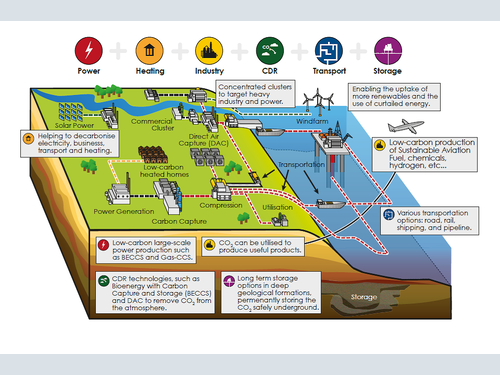
Introducing carbon capture and storage (CCS) into the EfW sector is increasingly important. This technology captures carbon dioxide (CO2) emissions from power plants (and other industrial processes) and prevents them from entering the atmosphere, storing emissions elsewhere. To emphasise its value, the UK Government made £21.7 billion across 25 years available for the first CCUS projects in the UK (October 2024).
Not long after that (December 2024), the UK Government issued a press release saying, “New waste incinerators will only receive planning approval if they meet strict new local and environmental conditions.” Adding that new projects would need to be carbon capture ready. Fast-forward to February 2026, the UK’s Environment Agency backs this further with a guidance document, Decarbonisation readiness in environmental permit applications, for new and substantially refurbished electricity-generating combustion power plants in England. It says that from the 28th February 2026 operators must demonstrate they are ‘decarbonisation ready’ as part of their environmental permit application under the Environmental Permitting (England and Wales) Regulations 2016. The message, therefore, surrounding CCS is clear.
Another development within the EfW sector is a delay in its inclusion in the UK Emissions Trading Scheme (ETS). Previously set to take effect in 2028, the UK Government delayed EfW’s inclusion within this scheme. A new timeline is being prepared. All these developments indicate that CCS provides EfW operators the means to generate energy and reduce their carbon footprint, while the UK ETS establishes when to incorporate EfW within its scheme.
Physics-based AI can support EfW operators here as they explore how to integrate CCS into existing plants and newly planned developments. Introducing CCS and CCUS will have an impact on all operating assets, especially high-temperature equipment. Using physics-AI within this context will help operators to model and understand the impact of any inclusion of this technology into a plant, be it for a retro-fit or new plant plans. Findings from the modelling will enable engineering teams to understand how to configure plant settings more effectively too. For example, they can establish and compare asset behaviour before and after modifications. The analysis produced will help them understand the impact of existing assets when CCS is introduced, or during the wider planning phase, providing valuable information that can be used during contract negotiations with equipment suppliers, for instance.
Conclusion
EfW has an important role to play in the UK’s energy and waste infrastructure. Its long-term success depends on plant availability, reliability and remaining commercially viable. For operators to achieve this, they must understand how intensive operations affect their critical assets, especially as they prepare to introduce CCS into the mix.
Physics-based AI can help provide vital engineering intelligence. It can quantify asset degradation and model the impact of any operational changes within plants. Importantly, too, it complements existing physical inspections and engineering expertise. With physics-based AI providing EfW operators the insight necessary to make better operational decisions; to target their maintenance strategies more effectively; and, ultimately, enable them to protect long-term asset integrity.