From Food Waste to Finished Compost in British Columbia
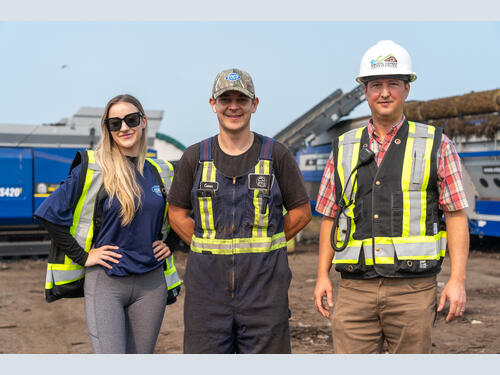


On the outskirts of Abbotsford, British Columbia, the Fraser Valley landscape is a world away from the quarries and construction sites that regularly fill the pages of Awesome Earthmovers. Yet the same principles of production, material movement and well matched equipment are very much at work at Pacific Coast Renewables. We travelled to the Canadian operation to see how EDGE Innovate equipment is helping turn municipal food and yard waste into a usable product for the local community, while dealing with one of the most demanding materials handling challenges there is: wet, inconsistent and often contaminated organic waste.
Pacific Coast Renewables, known locally as PCR, has been operating since 2012 and forms an important part of the region’s organics recovery infrastructure. Located at Gladwin Road in Abbotsford, the site accepts source separated organics, principally municipal food waste and green waste, which would otherwise be destined for landfill. The material is composted on site before being screened and distributed as finished compost. PCR is now part of EverGen Infrastructure, which has invested in upgrades at the facility as it continues to process organics from Abbotsford and neighbouring communities.
“We process source separated organics, which is primarily municipal food waste and yard waste, then compost and screen the material before providing it to the local community,” explained General Manager Michael Soy.
The importance of the operation becomes clear as soon as you look at the material arriving at the site. Even with food and garden waste separated at source, contamination remains a very real issue. Plastic, larger pieces of wood, stones and other unwanted material all make their way into the waste stream. For a compost producer, removing this material efficiently is essential. The finished product must be clean enough to be used with confidence by the local community, while the site needs to maintain a steady flow through its processing operation.
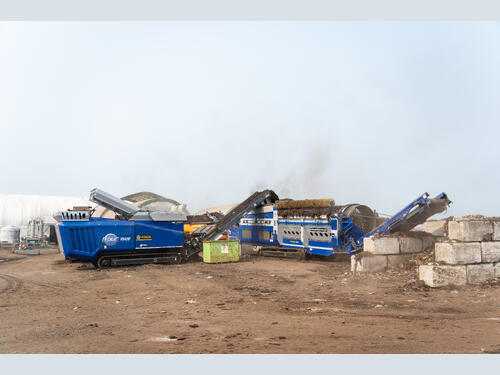
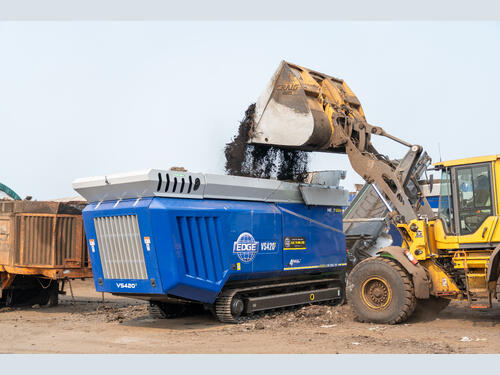
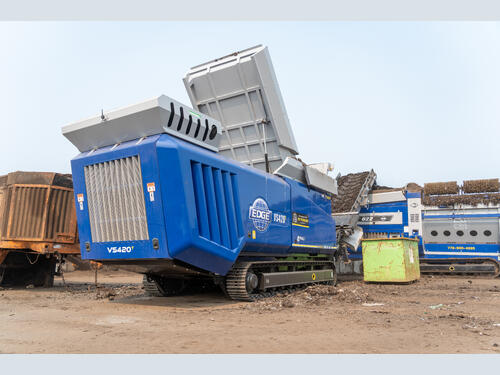
At the centre of the latest set up is an EDGE VS420 slow speed shredder feeding an EDGE TRT622 tracked trommel. The VS420 is a high capacity twin shaft shredder designed for difficult materials including green waste, biomass, municipal waste and construction waste. Its two synchronised, high torque shafts break material down before it reaches the trommel, helping create a more consistent feed. EDGE has designed the VS420 with a focus on resisting contaminants and reducing the risk of material wrapping around the shafts, both important considerations in an organics application where conditions can change from one load to the next.
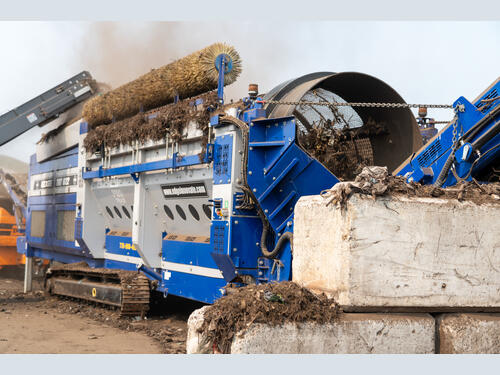
From there, the shredded material is fed into the TRT622, one of the larger tracked trommels in the EDGE range. The machine uses a 6.9 metre long drum, with variable speed and adjustable screening angle, giving operators the flexibility to work with different material types and moisture levels. At PCR, the trommel is fitted with a 1.5 inch wire mesh screen. This allows the operation to recover the compost fraction while separating larger woody debris, rocks and plastic residuals that have survived the earlier stages of the process.
General Manager Michael Soy explained that the need for the new equipment came from the nature of the material rather than a desire simply to increase capacity. PCR had previously used equipment better suited to aggregate handling, but the high moisture content in unscreened compost proved difficult to manage. The difference with the EDGE set up has been immediate. Soy told us that the company has effectively doubled its screening throughput, a sizeable gain in an operation where the volume of incoming material can quickly build up.
“We chose the EDGE equipment because of their organics focus and the ability to screen out the residuals in the unscreened compost,” Soy said. “We’re finding the EDGE equipment basically allows us to double our throughput on screening.”
One particularly useful feature of the TRT622 at this site is its dual discharge arrangement. Plastic contamination can easily become airborne, especially on an open recycling and composting site where wind is a constant factor. By discharging the finished compost and contaminated oversize at opposite ends of the machine, PCR can keep the unwanted material away from its finished stockpile.
“It keeps the highly contaminated material away from the finished goods, so it keeps our finished compost a lot cleaner,” Soy said.
It is a straightforward solution, but one that has made a real difference to housekeeping and to the cleanliness of the compost leaving the screening process.
Mobility is another important part of the package. As the day progresses, material naturally builds up around a busy trommel and shredder combination. Both EDGE machines are tracked and equipped with remote control functions, allowing the team to reposition equipment and clear the working area without unnecessary delay.
“At the end of the day there’s a lot of material on the ground, and having it on tracks and the remote controls allows us to move it out of the way and clean up the site,” Soy said.
That might sound like a small detail, but on a site handling wet organic material, keeping the work area organised makes a noticeable difference to both productivity and safety.
EDGE Innovate, based in Northern Ireland, has grown since its establishment in 2008 into a familiar name across the recycling, waste handling and quarrying sectors. Its range now includes trommels, shredders, feeders, stackers, screens and separation equipment operating across the world. At PCR, the appeal was not simply the size of the machines, but their suitability for organics. The ability to handle wetter material, remove contamination and maintain reliable daily production was clearly the deciding factor.
For Michael Soy and the Pacific Coast Renewables team, the results have been backed up by the support received from EDGE and local dealer ProTrack. Based in Hope, British Columbia, ProTrack is EDGE Innovate’s exclusive dealer for Western Canada, supporting customers with equipment expertise and ongoing technical back-up across the region. When a process has to work every day, responsive back up matters just as much as the equipment itself. “Our experience working with EDGE and ProTrack has been really good,” said Soy. “They’re very quick at responding to questions or if any issues come up.” On this visit, the VS420 and TRT622 showed exactly why purpose built recycling machinery is becoming increasingly important. What begins as a difficult mixture of food waste, garden waste and contamination is leaving the site as a cleaner, more useful compost product, ready to go back into the community it came from.
Associated Businesses
