Recycling success cannot lead to more tax, says MPA Scotland
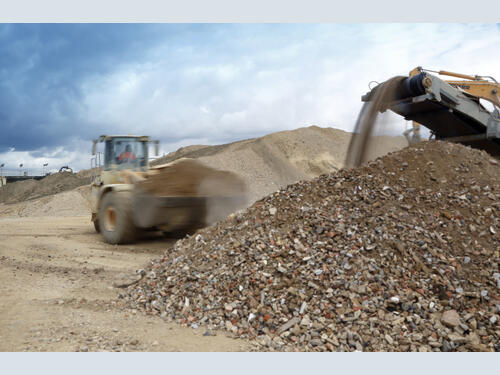
Fiscal measures to incentivise the recycling of construction waste have been highly effective in Scotland, but policy makers mustn’t burden operators with further taxes.
That’s according to a new report published last week by the Mineral Products Association Scotland (MPAS) whose members have helped drive the efficient reuse of recycled materials as an alternative to primary aggregate in Scottish construction.
The report – Contextual Review of Aggregates Production and Mineral Waste Recycling – was launched at an MPAS event at Prestonfield House, Edinburgh, attended by more than 120 people. Delegates included MSPs, MPs and senior officials from the Scottish Government, Transport Scotland, Revenue Scotland, Scottish Enterprise, Highlands & Islands Enterprise, and the RSPB, as well as operators, contractors and customers.
Speaking at the event, Scottish Conservative Deputy Leader Rachael Hamilton MSP noted the sector’s importance to the Scottish economy. She also stressed that diverging the rate of Scottish Aggregates Tax (SAT) from the rest of the UK would simply make production in Scotland more expensive, and damage the country’s competitiveness.
The new MPAS report reviews publicly available data to show that Scotland’s pursuit of circular economy objectives has been effective in encouraging recycling to produce aggregates suitable for some construction applications, reducing the pressure on newly-quarried primary materials.
In 2023, for example, out of a total 3.6 Mt (million tonnes) of mineral-related waste, 3.3 Mt was recycled in Scotland. The data also shows that 80% of excavation waste material classified as ‘soil and stones’ – and 97% of ‘mineral waste from construction and demolition’ – was recycled, with both rates continuing to trend toward the maximum achievable.
During the same year, the Scottish aggregates sector supplied Scotland’s construction industry with 15.5 Mt of primary aggregates. This means that although the contribution of recycled aggregates is relatively modest, it’s a meaningful part of the overall supply to the Scottish built environment. It also shows that even if all 3.6 Mtpa of mineral waste could be reused, there would still be significant demand for primary materials.
One of the objectives of the Scottish Aggregates Tax – which was fully devolved to the Scottish Government from April 2026 – is to increase the sustainability of the Scottish construction industry and incentivise recycling by taking primary aggregates.
But MPA Scotland says the potential to further reduce primary aggregates consumption through the SAT is inherently limited. The availability of waste feedstocks for recycling is constrained by levels of construction activity. And much of the remaining waste is either hazardous, contaminated, has inappropriate physical characteristics, or is at low volumes in remote locations. In these situations, given the small amounts involved, landfill may remain the best environmental and economic option.
The report concludes that further gains in mineral waste recycling are unlikely to be achieved by the SAT, and any increased tax rate would be subject to the ‘law of diminishing returns’ – for a given increment in tax levels, any increase in benefit becomes progressively smaller. This would unfairly penalise Scottish materials producers, with a knock-on impact for infrastructure delivery, and the wider Scottish construction sector.
Alan Doak, Director of MPA Scotland, said: “This report demonstrates clearly the exceptional work that our members, working with the wider construction sector, have done to increase the recycling of materials.
“There is a misconception that Scotland has a readily available source of recycled materials waiting to be tapped into and capable of significantly reducing the need for virgin aggregate – whilst the industry clearly recycles whatever it can – there is undoubtedly a limited feedstock available for producing recycled aggregate.
“By highlighting this key point, the report is intended to inform and support Scottish Government decisions to ensure that Scotland’s mineral products industry is capable of supplying the construction sector with the essential aggregates to meet future development objectives.”
“The mineral products sector is, quite literally, the foundation of Scotland’s economy, producing almost 30 million tonnes of aggregates, concrete, and asphalt per year across over 200 sites, making us the largest supplier to the construction sector, supplying essential materials for Scottish homes and infrastructure, and even manufacturing and agriculture.
“So a healthy mineral products sector is key for a healthy Scottish economy; and in order to achieve its objective of growing Scotland’s economy, the Scottish Government should ensure its budget supports investment in infrastructure, which has been lacking in recent years.
“Our sector has endured four years of declining sales across the UK, driven by low construction activity. This period has also seen an increase in the cumulative tax burden on businesses in our sector of up to 29% on a UK-wide basis and the Scottish Government must therefore avoid piling any more taxes on business or additional costs on the construction sector and supply chain. In particular the report demonstrates there’s no justification for increasing or diverging the Scottish Aggregates Tax, which would be highly damaging for our sector, the wider supply chain, and the Scottish economy.”
For more about MPA Scotland visit: www.mpascotland.org