Surging tax burden in a falling market: new report
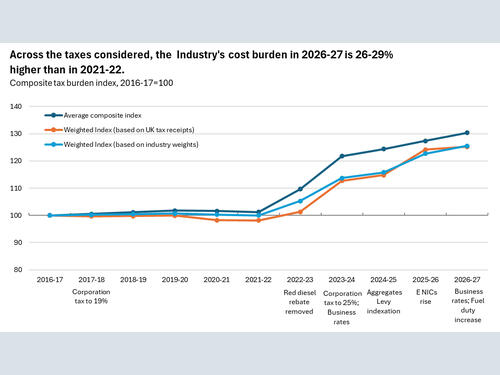
New analysis from the Mineral Products Association (MPA) has shown the tax burden on UK producers of construction materials and industrial minerals. MPA says the situation is stripping away business confidence and damaging industry investment.
The overall tax burden on the industry has grown up to 29% in just four years. The same four years has seen extremely weak market demand across the construction supply chain with sales of aggregates, ready-mixed concrete, asphalt and mortar hitting record lows.
This is a direct result of cumulative policy changes that have hampered the industry by increasing employers’ National Insurance Contributions, Corporation Tax, fuel duty and business rates.
Government pledges, including building 1.5 million new homes and delivering major transport and energy infrastructure, rely heavily on the mineral products sector to supply essential materials. An increase in the tax burden not only impacts industry confidence and investment but presents a real and growing risk to delivery of these promises.
Looking forward, industry leaders across major producing companies and SMEs say investment is critical to ensure a steady and adequate supply of aggregates from which hundreds of products are manufactured. The case for investment is weakened by an uncompetitive and growing tax burden, argues the association.
Aurelie Delannoy, Director of Economic Affairs at MPA said: “The tax burden on the mineral products industry has risen sharply since 2021-22, increasing business costs at a time when demand is already weak and economic uncertainty remains high. This is putting investment under real pressure across an industry that is essential to delivering housing and infrastructure ambitions.
“Government must now focus on stability - no further increases in business taxation in the near term, protected infrastructure spending with a clear commitment to delivery, and support for housing demand. Without this, there is a risk to jobs, capacity and future investment across the construction supply chain.”
Chris Leese, Executive Chair at MPA, said: “MPA members employ around 89,000 working people producing materials which quite literally form the foundation of our country; concrete products, aggregates, asphalt and cement to name a few.
“Our members are clear when they tell us that there has been a really noticeable increase in tax over recent years. In the current economic conditions, this is really holding the industry back. Our members want to grow and invest but every additional tax rise in this list makes that harder to do.
“Currently our sector faces hugely depressed levels of construction activity leading to historically low levels of outputs, while being crushed by rising costs and a rapidly increasing burden of taxation and regulation. This is threatening jobs, stifling investment and ultimately leading to a loss of capacity which could hold construction back when and if recovery comes.
“The Chancellor pledged to not raise taxes on working people, but she has raided the businesses that create and sustain their jobs. This follows similar decisions made under the previous Government, and as a country we need to change course quickly to create the conditions, right through the construction supply chain, that give confidence to invest.”
MPA has previously called on Government to act to support the industry and wider economy. Specific policy suggestions are:
- Support housing demand in the form of financial support for new home buyers.
- Rapid public funding for infrastructure. Any projects in the infrastructure pipeline that can be accelerated should be.
- Infrastructure and capital budgets must be protected.
- Incentivise private construction spending through a super-deduction. A super-deduction to bring forward investment and would be a significant catalyst to help to kickstart growth.
- Targeted support to help reduce costs for the construction sector. Incentives to initiate projects now would help, such as a super-deduction, a reduction in employer NICS or extending the exemption from VAT more widely.
- Deliver a robust Carbon Border Adjustment Mechanism that supports energy intensive industries to compete on a level playing field. The current design, and waiting until Q4 to announce rates, is undermining confidence.
- Address Industrial Energy costs for our sector by expanding access to the Energy Intensive Industries compensation scheme.