Integration is the key to success for the National Fluid Power Centre
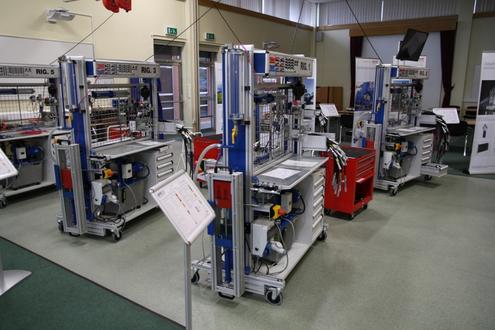
The National Fluid Power Centre (NFPC) prides itself on its reputation as a global training provider for those involved in the maintenance and management of fluid power systems and control and is recognised as the leader in industry training and development for integrated systems engineering.
The NFPC is fully approved by a number of international companies including such names as Bosch Rexroth, Hydac Technologies, Parker Hannifin, Eaton, Husco International, Danfoss , Moog, MP Filtri, Sun Hydraulics, Pall Filtration, Webtec Products and Shell Lubricants and the Centre has an advisory board with a membership of over 60 companies, making it the ultimate centre for knowledge, education and future industry development bringing together hydraulics, pneumatics, electronics and control.
The HUB went along to take a detailed tour of the centre and caught up with John R Savage, Director of the NFPC. “The business here is all about integrated systems engineering, bringing together hydraulics and pneumatics with electronics and control to give our customers a complete training package that guarantees that the workforce are able to manage things at a systems level.”
“Industry is no longer looking for people with a single skill, it is looking for people with an integrated systems approach, as the systems may well involve hydraulics, pneumatics, electronics and some form of control. Bringing together these different elements seamlessly is what the NFPC is all about, we are dedicated to professional training that enables people to be totally capable, able and competent around the whole system, whether that be a 30 tonne excavator, wheeled loader or recycling plant.”
“The facility here was opened in 2001 by the President of CETOP Signor Amadio Bolzani, Paul Cook the President of The British Fluid Power Association (BFPA) and the Managing Director of Bosch Rexroth (UK). The cost of the initial building was in the region of £2m, and we now have over £3m of the latest technology within it, possibly the best practical training facilities in Europe.”
“This is all made possible by our dedicated Advisory Board, with many companies supplying the latest products to us so that we are completely up to date with technology. The facility has a very ‘hands-on’ approach and we encourage learning on the real thing, replicating things here that engineers and technicians can effectively do in their workplace, so that when they return to work they apply their maintenance techniques better than ever before whilst following safe working procedures. Since opening, around 28,000 engineers and technicians have attended the NFPC.”
“Recently we have set-up satellite centres around the UK, based on the sites of our advisory members. These 23 centres have become a very effective feed into the NFPC for the more advanced work and training. Bespoke training is also something that we offer placing our training engineers onsite to specifically investigate customers training needs around their own equipment, then developing a training course around those needs and finally delivering that training. An example of this is Komatsu UK, where we have provided bespoke training for nearly 20yrs.”
“We are very keen on competence levels, and we best describe this as a combination of skills and knowledge to carry out a particular task in a given amount of time, meeting a set of standards, whilst following safe working procedures, and with repeatability.”
“Our goal is to educate, train and develop key skills, but also assess their competence. Here at the NFPC we are currently building more and more competence based assessments into our standard training programmes, making us unique in the marketplace. We are also committed to continued professional development and in September 2016 we will be launching individual candidate CPD record booklets, allowing for complete monitoring of competence and skills, as the different steps are taken within the programme, giving candidates an NFPC stamp for each stage successfully achieved. This will be extremely valuable for employees and ultimately help employers with their own quality systems in monitoring staff development.”
The NFPC is a BFPA Certified CETOP Education Centre and delivers a range of competence based training programmes following CETOP Recommendations.
At present a candidate passes through several stages to gain a Level 3 CETOP qualification, and this includes stage 1 and 2 hydraulics. It usually takes around 3 years to gain a level 3 CETOP qualification, the highest qualification currently awarded by CETOP.
CETOP is the umbrella organisation throughout Europe for all Fluid Power Trade Associations and within the UK, The British Fluid Power Association is the CETOP member, promoting CETOP Education Recommendations CETOP stands for ‘commission European transmission oil and pneumatics’.
John further commented “As an organisation we are now looking at supporting apprenticeship programmes, and will be launching a new range of courses under the banner of “Foundation in Integrated Systems Engineering”. We believe that where apprentices are transitioning between an engineering programme and new place of work, it is an ideal time to train them by means of the new ‘National Fluid Power Centre integrated fluid power systems foundation programme’ which consists of hydraulics, pneumatics, electronics and control, giving them a good foundation in integrated systems engineering.”
We asked John about the growing mobile marketplace “We are doing more and more business within the mobile sector. Once again companies want their staff to be trained at a systems level with a knowledge of the machine hydraulic system, on-board controls, engine management system and microprocessor controls. This is where integrated control systems have become key in the development of new machines. We must therefore ensure that today’s Engineers are able to match this technology with their knowledge and skills. This is where the NFPC plays a vital role both present and in the future in matching human skills and knowledge to changes in technology.”
The Facility
We were given a complete guided tour of the facility. The building is extremely well organised and is split into several different training areas. The first thing to note is that all the team at the NFPC have come from UK industry and so have lots of experience and expertise, and the ability to transfer skills and knowledge effectively. The centre is very flexible in the timing of courses, working with companies to tailor dates that work with their availability, and are quite happy to run courses at weekends and run courses with small numbers if required.
Technical centre 1 is a very flexible space which can be turned into various layouts to suit the training. It includes bespoke hydraulic training rigs supplied by Bosch Rexroth allowing candidates to move straight from classroom to lab within seconds to get ‘hands-on’ with the training.
After graduating Technical centre 1, candidates move to Technical centre 2 which has been developed to cover the maintenance and management of fluid power systems, including fault diagnosis and prevention. This space contains a special ‘mobile equipment’ specific training area featuring a fully operational CAT engine transmission system from a 906 shovel loader which can be interfaced with a Danfoss or Parker micro-processor to give a real-time learning environment for candidates. A fully operational small JCB excavator is also available with contamination monitoring equipment and potentiometers. There is an area specifically for oil analysis to make sure contamination control and prevention is fully covered, including microscopes and automatic particle counters.
Moving upstairs we were presented with Technical centre 3, an exciting world of integrated fluid power systems and control. Here candidates get hands-on with electronic control interfaces, where electro hydraulics and electro pneumatics are covered in great depth. Companies who support and are involved within this area include Deep Sea Electronics, Star, Hydrastore, Balluff, Rexroth, Seimens, MOOG, Hydac, Danfoss, Eaton, Parker, Rockwell Automation, ABB and Mitsubishi.
Five Year Plan
The exciting, potential five year plan for the NFPC is to develop a brand new state of the art engineering based training facility which will integrate seamlessly with the current building, allowing for massive increased capacity and extra parking. This new building will be designed to add more of the electronics element to the training facility as the centre continues to grow and lead the way in integrated systems engineering.
John ended the tour by summing their success up “We are proud that we have successfully managed to get major international companies, who are competitors, under one roof, working together, supporting The National Fluid Power Centre, and placing thousands of pounds worth of high tech equipment within it to benefit the whole industry. Our whole Advisory Board are also passionate about education and training and working with us to make this a very unique operation indeed.”
Industry Open Day 2017
We also talked with Sue Smith, Business Development Manager about the centres upcoming open day in 2017. “Attracting more than 70 UK and international companies, the NFPC open day is a showcase for the centre, a platform for business networking and an educational event with four key speakers from industry delivering professional technical lectures. We had over 300 visitors in 2016 and reports from our exhibitors confirmed to us that business was actually initiated at the event, in fact quite a few exhibitors made the comment that for the minimal investment involved, the return was far better than some larger exhibitions that they had attended. The event in 2017 is on the 15th February and we will have a 60m marquee in front of the building for all of our exhibitors. We look forward to another very successful event.”
For more information on The National Fluid Power Centre please call Sue Smith on 01909 504722 or visit us online at www.nfpc.co.uk