Silt and water management
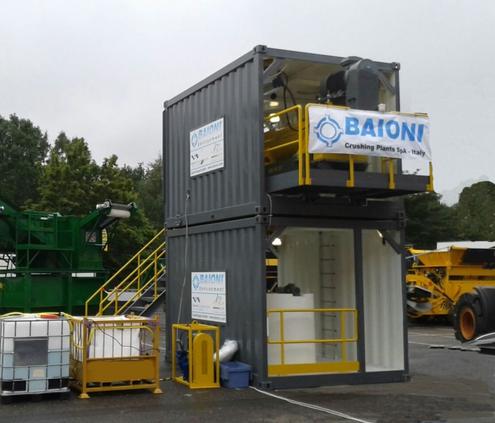
In an attempt to protect our ecological surroundings and minimize the negative effects of industrial processes, it is necessary to purify and recover the waters used during washing operations of sand washing, quarrying and recycling operations. The first step is to recover 100% of the waters used and to eliminate the concentration of sludge, thus Baioni's solutions aim at offering a full sludge treatment system that includes the latest generation of thickeners, polyelectrolyte dosing system, high performance horizontal centrifuges, filter presses, Pod systems.
Silt and water management today is becoming one of the most important environmental challenges especially with recycled aggregate washing plants that generally do not have large areas of land to store and settle silts and water for reuse. Traditionally sand and gravel plants have used existing working areas for lagoons and for settling silt from washing operations, extensive areas of about 10 hectares and sometimes even larger can simply be dealt with a 8 metre diameter thickener.
The introduction of Baioni system, thickeners above all, brings significant cost savings as it reduces the area previously required to accommodate ponds or lagoons. It is a compact design for rapid installation and minimum down time, pumps and accessories are outside allowing easy access and maintenance. It also reduces the volume of fresh water required to feed the washing plant by up to 80% as there is a constant water flow during the process.
Baioni thickeners/clarifiers are environmentally friendly being low power consumption, low maintenance costs, designed with minimal operator attendance. They work on the process of settling the silts in the base cone and the top of the thickener reclaims the clarified water providing immediately reusable process back to the plant. The underflow sludge from the bottom of the thickener can be dealt with the use of plate presses, horizontal high performace centrifuges and belt presses, this in turn produces dewatered sludge and turns it in to transportable solids which can be stacked without further release of water. Recently the company have launched and introduced the Plug-and-Go Centripod system using the well proven Baidec high performance decanter, designed into a Pod system which can be fast installed and operational within the same day of delivery.
BESPOKE AGGREGATE WASHING PLANTS
Bespoke aggregate washing plants are starting to be more in demand with high outputs and high quality required which can usually only be associated with fixed and modular plants. With the demand for higher quality, the question is: do you use high attrition or low attrition scrubbing? The general rule is that if the material processed contains a high percentage of silt and clay, high attrition is the choice, by using log washer in which clays and other deleterious materials are removed by material on material scrubbing. This piece of equipment has clearly higher running costs due to high wear and high power consumption, besides higher water requirement.
Low attrition by using scrubbing barrels (cylindrical drums) are most beneficial especially for materials which do not have sticky clay or deposits on aggregates, they are anyhow able to remove clay contaminants or other deleterious materials from sand, gravel, stones while having low running costs as they are low in power and water requirement and low in maintenance costs.
Baioni company is able to offer custom engineered process solutions to address the specific needs of each customer's application; bespoke plants and a comprehensive range of equipment for the washing and classifying aggregates process, for scrubbing, decontaminating and dewatering sand. Facilities using the latest 2D and 3D CAD design systems, entirely manufactured in Baioni factory works.
BESPOKE CRUSHING PLANTS
The new era of fixed and modular crushing plants is the one that caters to every client demands with emphasis on process efficiency and product enhancement with the value being mainly in the smaller sizes below 40mm.
A recent Baioni static crushing installation has helped Suttle Stone Quarries company in the Swanworth Quarry to increase aggregates production through the use of a crushing plant which includes the design, fabrication, installation of a primary unit consisting of the ACP reciprocating stepped feeder on to the GD elliptical roll grizzly which screens out the heavy clay - both of these pieces of equipment are very good at processing sticky clay burden stone. Material is then fed on to the MIP impact crusher capable of up to 220 tph.
Quarry director, Simon Clabburn, needed to address the difficult quarry conditions having heavy stick clay seams between good quality Portland stone. The aim was to produce 200 thp of minus 40mm with a primary crusher, also incorporating an existing own mobile crusher for specific smaller sizes.
This is a typical example of what can be achieved by Baioni design engineers after analysing quarry conditions of local and regional market requirements, using the latest 2D and 3D CAD design software and AggFlow simulation program which is recognized for delivering quality results with incredible accuracy.