They cried “Wolf Minerals” when the beast of Lee Moor arrived on the edge of Dartmoor, Devon.
Author Jeff Buxton
Australian Company, Wolf Minerals £130m tungsten site on the edge of Dartmoor will when fully operational will be one of the world’s most important tungsten mines producing 5000 tonnes a year.
Charlie Northfield, process plant manager, for the Wolf Mineral site commented, “We plan to be producing between 3,500 and 5000 tonnes per year of tungsten concentrate – about 3.5% of the global forecast demand”. Wolf Minerals, the Australian company building and operating the mine, claim 200 jobs will be directly created and stated that the £130m project will plough millions of pounds into the Devon economy every year.
The history
The Hemerdon site located close to Lee Moor area is situated approximately 5km from Plymouth coastal harbour. Renowned for its mining heritage the industry has been a provider and key driver of the local economy. Large scale, china clay and aggregates operations continue in the area, which has been extensively mined since the mid nineteenth century. Charlie said, “If things go to plan, there is a great future for mining of tungsten and mining again in this area of Devon”.
The road to realising their plans to mine tungsten has not been easy. Tungsten was first discovered at Hemerdon, as far back as 1867 and such is the scale of the deposit that the site is now recognised by the British Geological Survey as the fourth largest tungsten resource in the world.
Although by today’s standards relatively small in scale the first significant workings took place between the period of the first and second world war when mines were built and production commenced.
With operations coming to a halt in 1944 due to the resumption of shipments of tungsten from overseas further attempts continued during the 1960s and early 1970s to reopen the mine, but failed.
The future
In the late 1970s an American mining company AMAX became involved and a significant explority programme of drilling got underway. In 1981 a planning application was submitted to mine tungsten and following a public enquiry in 1982 the Secretary of State indicated that the improvements to the visual aspects of the processing plant and waste disposals area would be regarded more favourably in a new submission. A revised plan was subsequently submitted in 1985 which was passed by Devon County council in 1986.
Planning permissions to mine tungsten at Hemerdon are now in place until 2021 and were recently updated by Wolf Minerals in 2011, with the approval of Devon County Council and the Secretary of State for communities and local government.
In 2011 Wolf Minerals completed and published a definitive feasibility study and the following year the 600m link road was completed and opened between Lee Moor Road and West Park Hill in Plympton. In 2013 the project financial deal was completed followed closely by the processing plant & infrastructure final design.
In 2013 GR Engineering, another Australian company specialising in mineral extraction projects appointed EPC as a main contractor to work in conjunction with Wolf Minerals to deliver the project on their behalf. With GR Engineering working with Wolf Minerals to design and build to implement the process equipment scope of works to meet the process needs key process equipment and services were identified and suppliers invited to tender.
One of these processes was the supply of 10 linear screens used for the separation of the size fractions of raw and finished material within the process streams. Don Valley Engineering was identified as a manufacturer and following technical discussion and visits by GR Engineering to their Doncaster Works, were eventually selected as the preferred supplier and awarded a contract to supply 10 Linear screens, ranging from 9.0m² to 64m² with single and double deck screening areas and throughput rates in excess of 1200tph.
The scope of work and project schedule called for the design, supply and delivery in the second quarter of 2014, including individual screen testing and FAT(Factory Acceptance Testing).
Work to commission the mine, its processing plant and other decommissioning of old infrastructure commenced in 2013. Whilst the initial phase of the operation involves the detailed design of the processing plant and off site fabrication.
The extraction process
The extraction of tungsten will take place through open pit mining with the pit measuring about 850m long by 450m wide extending 200m. The sides of the pit will be cut in benches to allow for safe working as the depth of the mine increases. Most of the valuable tungsten and tin at Hemerdon can be found within the large deposits of granite which contains veins of quartz / tungsten which can be found and identified by diamond drilling.
Material extracted from the mine will be transferred by a raw feed conveyor that will deliver the material to the primary crusher. The crushed material will then be transferred to the scrubber screen and product screen before the DMS Feed Screen, the process stream then splits into two streams, feeding the primary sinks 01 screen and 02 screen and primary floats screen O1 and screen 02, before being fed onto the secondary DMS screen and to the primary mill sizing screen.
Contract award
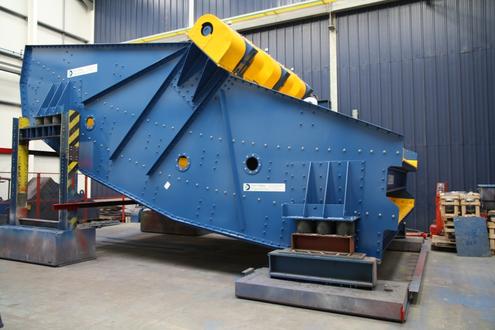
Upon award of the contract, the Don Valley Engineering design team, set about designing and detailing each screen to meet the screening requirements of the user requirement provided by the process flow diagram and equipment specification. Each screen was individually designed and one of the screens in particular is believed to be the largest double deck screen to be supplied in the UK by Don Valley Engineering.
Measuring 8.1m in length and 4.0m wide the screen has pushed the envelope of screening technology for gross weight, weighing in at some 32 tonnes with a screening surface area of two screen decks each measuring 32m², totalling 64m², designed to minimise the footprint of the plant. The size of this screen is believed to be the largest screen in the UK.
Manufactured by Don Valley Engineering the company have produced longer screens and larger throughput rates, but not at this weight or screening design ratio. The unique design of the banana screen (so called because of the curved screen area), allows the design of the feed chute to achieve maximum feed properties, whilst reducing the angle of the screen decks, thus providing maximum screening properties to be obtained over the screening area footprint.
In the second week of June 2014, Don Valley Engineering completed the final logistical stage of the contract. Allowing GR Engineering to meet their obligations to Wolf Minerals and take delivery of the 10 linear screens, delivered on time as per the contract program. The first screens were off loaded and will be stored ready for mechanical installation as per the project program. The large screen required a police escort and was delayed by police for 36 hours to allow the road works on the exit of the M5 to be rearranged to allow the large load to pass safely.