Vortex Assists Sanitation Efforts at a Waste-to-Energy Facility
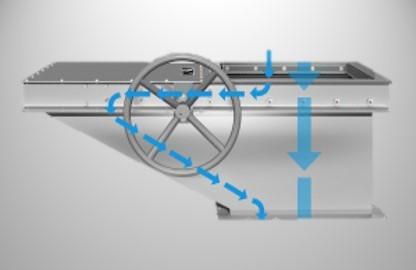
In 2007, a county sanitation district approached Vortex to discuss a process need in their waste-to-energy power plant. Under their previous process, the plant used manually actuated slide gates to isolate a hopper, filled with incinerator bottom ash and fly ash, from a drag chain conveyor. When the gate is opened, hot ashes discharge into the drag chain conveyor. As the hot ashes convey, they cool before being evacuated from the process.
Of the pre-existing slide gates, the plant had two primary complaints:
- Though the gates were manually actuated, they did not actuate well. A sledge hammer was needed to drive the gates closed. To be reopened, each gate required maintenance and downtime. These processes were cumbersome, labor-intensive and were performed weekly.
- The gates often leaked steam and materials to atmosphere. When steam is leaked to atmosphere, it reduces the efficiency of the steam generator – which also reduces the total output of electricity. Because some municipal solid wastes also contain hazardous materials, this can create health and safety concerns if ashes are leaked to atmosphere.
The Vortex Aggregate Gate was recommended as the solution to each of these problems.
Gate Specifications:
- Size: 18 in | 455 mm
- Pneumatically actuated, using a double-acting air cylinder actuator.
- Rated for handled material temperatures of 400° F | 205° C (max.) continuous service.
- Bonnet seal to hinder materials from migrating into the bonnet area.
- Return pan to contain fine materials.
- Valve body, blade & material contact areas constructed from 304 stainless steel, to resist oxidation & corrosion.
- Blade rollers constructed from 304 stainless steel & bronze.
- Roller spacers & bonnet blade guides constructed from 25% glass-filled Teflon™.
- Side seals, end seal & upper bonnet seal constructed from high-heat rubber belting.
- Air cylinder seals constructed from Viton™, for temperature resistance.
- Air cylinder equipped with a magnetic piston, to accommodate magnetic reed switches for blade position indication.
- By introducing pneumatic actuation, the Vortex Aggregate Gates are able to be opened and closed quickly, simply, and without significant manpower.
On the opening stroke, each gate’s bonnet seal acts as a “squeegee” to force materials remaining along the blade to fall away into the process line below, rather than migrating into the bonnet area.
When using a return pan, on the top part of the gate, a solid bonnet cover is used. On the bottom part of the gate, the return pan replaces the lower bonnet cover. As materials migrate into the bonnet area, rather than building up, they are deposited down onto the return pan, to be reintroduced into the material flow stream.
Benefits of a return pan include:
- An inexpensive way to prevent dusting to atmosphere. This improves housekeeping and workplace safety, and prevents product loss.
- An effective solution to prevent material build-up in the bonnet area, which could otherwise cause gate actuation issues
Today, this waste-to-energy power plant operates six Vortex Aggregate Gates, all of similar design.