WD-40 Introduces WD-40 Specialist® Bio Lubricant Multi-Use
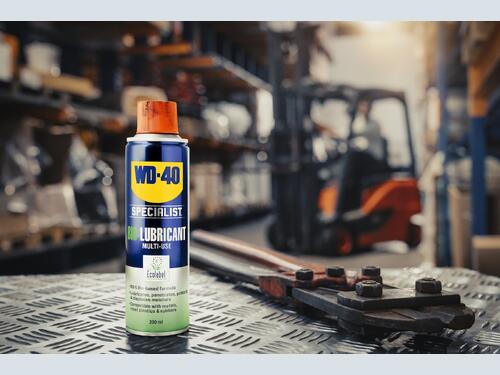
Developed for maintenance, facility management and light industrial environments, the new lubricant delivers
multi-purpose performance while meeting the stringent environmental requirements of the EU Ecolabel.
WD-40 Company Limited, a global leader in maintenance and lubrication products, is proud to announce the
launch of its new WD-40 Specialist® Bio Lubricant Multi-Use. Innovation has defined the WD-40® brand for
more than 70 years, and WD-40 Company Limited continues that legacy with the launch of the first multi-use
product in our category certified under the EU Ecolabel lubricant criteria (Decision (EU) 2018/1702).
Made with 85% bio-based ingredients, the product meets the strict environmental standards of the EU
Ecolabel while delivering the professional-grade performance end users expect. Its versatile formula enables
the product to perform several core functions —penetrating, lubricating, and protecting—and is ideal for
home and workshop use, outdoor and garden tools as well as facility and bike maintenance and light
industrial applications.
The EU Ecolabel is a rigorous, voluntary certification managed by the European Commission and
independent bodies. Earning this label requires a product to demonstrate reduced environmental impact
across its entire lifecycle, from raw material sourcing and manufacturing to use and end-of-life disposal.
“For more than 70 years, WD-40 Company has helped people solve everyday problems,” said Steve Brass,
president and CEO of WD-40 Company. “With the launch of WD-40 Specialist Bio Lubricant Multi-Use, we
are extending that legacy and proving that our product can meet strict sustainability standards without
compromising effectiveness. This launch is also a demonstration of our commitment to environmental
stewardship, practical innovation and doing the right thing.”
WD-40 Company has an aspiration to reach net-zero greenhouse gas emissions by 2050. The company’s
impact strategy integrates environmental, social, and governance (ESG) priorities to support long-term value
creation, focusing on operational net zero, product safety, circular economy principles and responsible
materials use.