Controlling Quarry Dust at Conveyor Transfer Points


R. Todd Swinderman, P.E. / President Emeritus / Martin Engineering
Ask any quarry operator, and they will agree that prioritizing worker safety and longevity is essential. Safety starts with dust suppression. Controlling dust also makes operational sense, as it can foul rolling components, machinery, and equipment air intakes, necessitating additional parts and labor for cleaning and maintenance. All these factors unnecessarily increase operational costs, especially when methods and technologies exist to control and suppress dust emissions before they become airborne and create these risks.
While reducing dust emissions from processing is clear, it is not always practical or easy to achieve. Numerous dust sources must be managed, depending on the extraction, haulage, and storage methods employed. Most dust in bulk materials originates from particle-size reduction by crushing or grinding, as well as from transfers between production steps, such as conveyor transfer points or during discharge onto a stockpile.
Causes of Dust on Conveyors
Conveyors are a significant source of dust emissions, yet they can also help reduce fugitive dust. For instance, in pit crushing and overland conveying at a surface mine, total site dust generation is lower compared to truck haulage. Some raw materials are easily wind-swept, and in some cases, an enclosed conveyor belt system may be necessary.
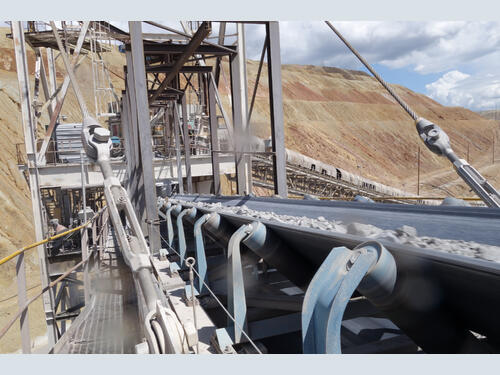
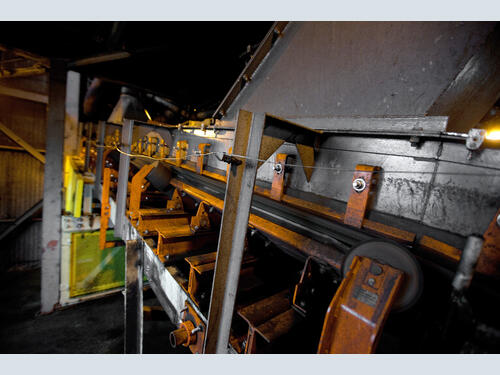
When the haulage involves a conveyor belt, dust generation depends on the loading and discharge processes, as well as the management of these processes. Closed conveyors are highly effective at preventing contamination and shielding the cargo from environmental elements, but they must still be opened and closed for loading and discharge. Passive dust reduction strategies include:
- Shorter or directed drops – Transfer chutes over loading zones that minimize the impact of cargo on the belt below reduce the turbulence within the loading zone, thereby decreasing the amount of dust released.
- Managing the Flow - While rock boxes can be effective, they are also susceptible to clogging. Therefore, experienced engineers recommend a sloping system that slows material to minimize impact and induced air, along with loads in the center of the belt to reduce shifting and enhance belt training.
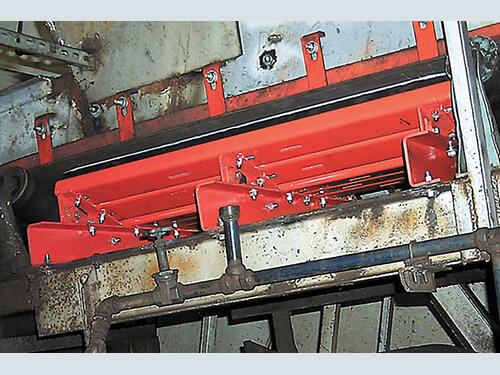
- Preventing belt sag between idlers – The belt can dip slightly between idlers, creating gaps between the belt and skirting that allow dust and fines to escape in the loading zone. Using an impact cradle with shock-absorbent polyurethane bars reduces impact strain on the belt and ensures an even belt plane without gaps between the skirting and belt. Cradles can extend along the entire length of the stilling zone.
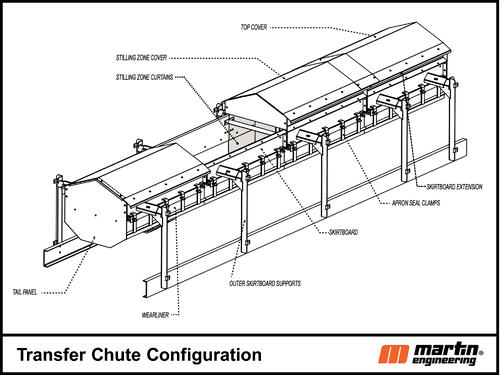
- Fully enclosed transfers – By completely enclosing the loading and settling zone, dust is contained. Items like dust curtains and dust bags can then be added to control airflow and capture dust.
Raw and Processed Material Storage
Controlling dust at the storage location presents another challenge. Large stockpiles are impractical to enclose in buildings and are often stacked and reclaimed by machinery that generates additional fines. Open stockpiles are subject to weather conditions, causing some bulk materials to degrade when exposed to the atmosphere, while others revert to a solid state when exposed to humidity or rain. Materials that can be wetted often use water sprays to reduce windblown dust. Other strategies include wind fences and pile compaction.
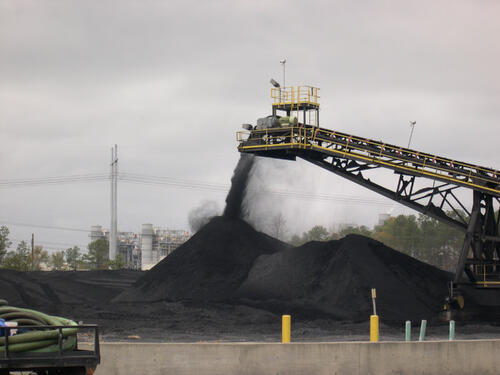
Discharge onto the pile is a source of dust release as the material flows from the delivery equipment, often a conveyor, onto the pile. Cascading or telescoping chutes can be used to reduce the release of dust in these cases. If the material is easily broken, the drop height from discharge to the pile or between cascade shelves can create additional dust from impact degradation. One unexpected source of dust emissions can be the site layout. For example, if a slope conveyor going from the stockpile into a storage bin or building is oriented in line with the prevailing winds in a high wind locale, the wind flowing up the conveyor will overwhelm dust control strategies by creating positive pressure throughout the conveyor enclosures.
Control the Air, Control the Dust
If the material stream can be constrained so that it does not open up when discharged, the amount of air induced into the transfer point is minimized. As the material particles disperse, they create a low-pressure zone in the spaces, which encourages airflow into the transfer point.
The amount of dust that can become airborne is directly proportional to the volume and speed of the airflow through the transfer point. If the openings in the chute are restricted to the practical minimum, the inward airflow is limited. A useful dust control strategy is to capture the material shortly after discharge and keep the stream coalesced as tightly as possible to minimize induced air.
There are several Discrete Element Modeling (DEM) software programs specifically designed for optimizing material flow through chutes, and there are specialty chute manufacturers that focus on these techniques. These chutes perform best with materials that have consistent size along with adhesive and cohesive properties, such as coal. Wear on the chute surfaces may accelerate; however, this can be mitigated by a maintenance-friendly design that allows for quick and easy replacement of wear surfaces.
Conclusion
Much emphasis is placed on planning the mine to maximize profitability, but little attention is paid during the initial feasibility studies to how the layout can affect dust creation and emissions. Conveyor transfer points have historically been drafted rather than designed. Design tools are now readily available to address these critical details. How the conveyor is operated and maintained also significantly affects dust generation and release.