‘No sign of recovery’ in construction demand, warns MPA


• New figures show sales of concrete, aggregates and mortar fell again in Q1 2026, prolonging the four-year downturn.
• Annual ready-mixed concrete volumes in London over the past 12 months were almost half what they were in 2022.
• Cost pressures and risks are rising, driven by conflict in the Middle East, with early signs of cost-driven project delays.
UK demand for essential construction materials fell further in the first quarter of 2026, according to the latest survey by the Mineral Products Association (MPA). Declining sales of aggregates, concrete and mortar in have prompted the MPA to reiterate its calls for Government to take steps to increase confidence, encourage investment and stimulate growth.
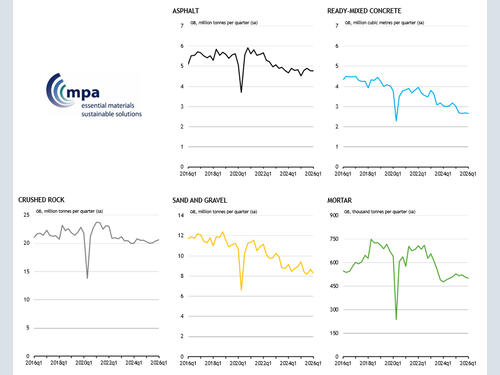
Sales of mortar, which closely track housebuilding activity, fell by 2% compared to the previous quarter and were 5.4% lower than a year earlier. Primary aggregates and ready-mixed concrete sales, widely used across construction, also declined by 0.8% and 0.5% respectively in Q1. Asphalt sales were broadly flat over the quarter (-0.1%), supported by a short-term boost to road maintenance activity ahead of the financial year end.
The Q1 data points to persistently subdued demand, with housebuilding dragging down overall material sales, even after accounting for short-term disruption from above-average rainfall early in the year. The results highlight growing pressure on the mineral products industry, as rising costs coincide with already falling demand.
Commenting on the latest data, Aurelie Delannoy, Director of Economic Affairs, said: “The Q1 data largely predates the recent escalation in global risks and energy prices, but it shows that UK construction demand was still falling as costs were starting to rise. Since February, early indications from MPA members point to higher fuel and production costs, alongside emerging signs of project delays and pauses, particularly on some lower-margin housing schemes.
“This is not just an energy cost story. The industry is being squeezed from both sides at the worst possible time. After four years of downturn, such pressure increases the risk of a more prolonged decline, rather than the recovery many had expected – or at least hoped for – this year.”
Weakness in housing and commercial construction continue to weigh heavily on demand. Higher borrowing costs and uncertainty are already affecting investment decisions, while long-standing affordability challenges will remain a key constraint on new housing this year. Together, these sectors account for around half of ready-mixed concrete demand, helping to explain why sales remain at historically low levels. The downturn is particularly pronounced in London, where annual concrete volumes over the past 12 months were 47% lower than in 2022.
By contrast, infrastructure remains the only area providing limited support. Major projects such as HS2 and Sizewell C have underpinned demand for aggregates, with crushed rock volumes rising modestly in Q1. However, this remains insufficient to offset broader weakness across construction markets.
Chris Leese, Executive Chair at the MPA, said: “There is no sign of recovery in the Q1 data, and this is likely to be further compounded by the economic fallout from events in the Middle East. Demand is still falling, and now costs are rising again. That is a difficult combination for any industry, and it raises real concerns about the outlook for construction this year.
“If this continues, we are looking at a fifth consecutive year of decline. That has consequences not just for our sector, but for the UK’s ability to deliver housing and essential infrastructure that supports energy security, transport and defence.”
Subdued economic growth, high borrowing costs and rising cost pressures continue to constrain project pipelines and business confidence. With the market previously expected to remain broadly flat in 2026, the latest evidence from Q1 points to a worsening outlook for construction and mineral products markets this year and next.
Even before the events in the Middle East, MPA had asked Government to act to increase confidence, encourage investment and stimulate growth to address what has become a “dire situation”. The MPA contends that there are key opportunities for immediate intervention which could have rapid economic and social benefits:
1. Support housing demand in the form of financial support for new home buyers.
2. Rapid public funding into infrastructure, in particular road maintenance.
3. Incentivise private construction investment through a super-deduction.
4. Targeted support to reduce costs for the construction sector.
Table 1. MPA sales volumes in GB: change on the previous period (seasonally adjusted)
| Asphalt | Ready-mixed concrete* | Sand & Gravel | Mortar | |
2023 | -6.9% | -6.5% | -4.2% | -7.4% | -15.0% |
2024 | -2.5% | -10.9% | -0.3% | -6.8% | -15.0% |
2025 | -1.0% | -9.9% | -1.3% | -1.5% | 5.2% |
|
|
|
|
|
|
2025Q2 | 5.5% | -11.1% | -1.2% | -10.3% | -2.4% |
2025Q3 | 2.4% | -1.0% | 0.6% | -2.8% | 0.8% |
2025Q4 | -2.8% | 0.8% | 1.4% | 5.9% | -2.0% |
2026Q1 | -0.1% | -0.5% | 1.0% | -5.0% | -2.0% |
Asphalt Ready-mixed concrete* Crushed rock Sand & Gravel Mortar