Sealing the Deal: Recycling Conveyor Dust Control


By Oliver Kämpfer – Martin Engineering DACH
Recycling commercial wastes, industrial byproducts, metals, electronics, biomass, cardboard, paper, and plastics is now firmly at the heart of the raw material supply chain
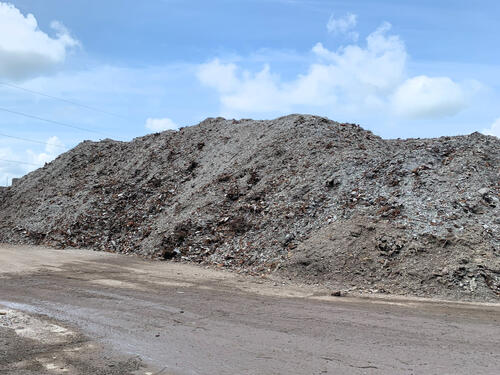
Within these waste streams, fine materials can account for a substantial share of the total output, requiring spillage and dust control. Fugitive dust emissions create an unhealthy work environment both inside and outside the plant. To make matters worse, certain wastes emit toxic particulates during processing, especially materials with corrosive properties, adhesives, coatings, and other hazardous substances. [Fig.1]
Particulates matter
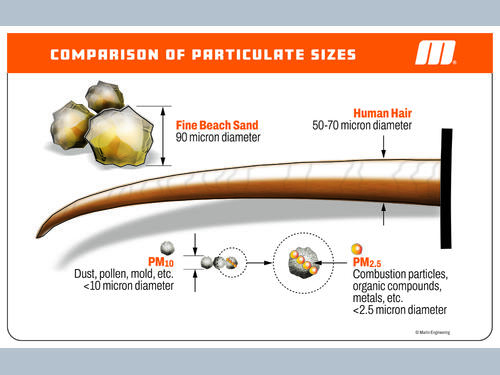
Although most of this particulate matter (PM) is considered little more than a nuisance, particles ≤100 microns (μm) in size are considered ‘inhalable,’ and particles smaller than PM40 (≤40 μm) are usually invisible to the naked eye. Many recycling processes emit particles smaller than PM10 (≤10 μm), which are considered ‘respirable.’ PM2.5 (≤2.5 μm), known as fine particles, can penetrate deeply into the lungs. At this level, some particles cross into the bloodstream. [Fig.2]
Maintenance teams often struggle to stay on top of cleanup, leading to workplace safety violations. Additionally, dust is known to foul exposed machine components, causing them to wear faster and require servicing and replacement sooner. Particulates also clog equipment air intakes, necessitating additional maintenance and downtime.
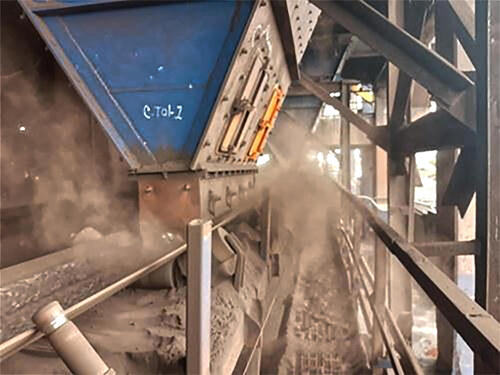
Aside from crushing, grinding, and shredding, the most common sources of dust in any recycling plant are conveyor transfer points. As loose material drops onto a conveyor belt, particulates disperse into the air. [Fig.3]
Containment is key
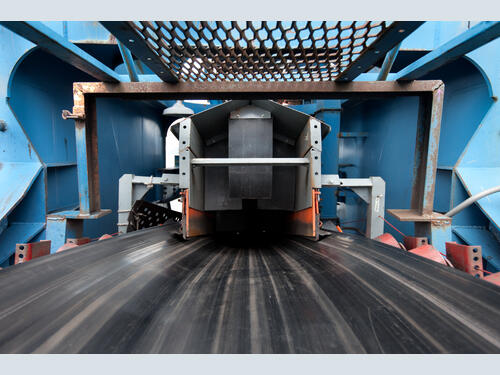
Poor transfer point design is among the main causes of dust emissions. Turbulence in the loading zone creates pressure in the transfer point enclosure, which forces airborne dust out of any available opening. Operators generally find that passive dust control through retrofitted transfer-point design changes is more practical and cost-effective than misting systems or HVAC solutions.
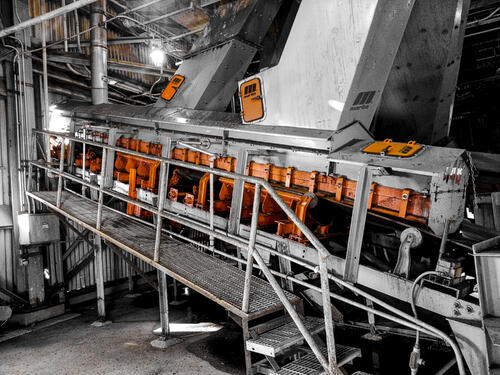
Well-designed transfer chutes have several key features that minimise the dispersal of fine material as it drops and settles onto a conveyor belt. Firstly, the length, angle, size, and shape of a chute dictate precisely how material arrives onto the belt below. For example, with centered, sloped, and spoon-shaped chute configurations, material is eased onto the belt with less impact and little or no rebounding. This design reduces air turbulence and minimizes load shifting. [Fig.4]
Skirt around the subject
Along the length of the loading zone, the entire enclosure needs to be well-sealed with belt skirting.
• Single skirting should be cut to match the belt’s trough angle for a tighter seal. The best designs can be mounted externally for easy and safe adjustment.
• Dual skirting is an engineered design that incorporates a primary and secondary seal, providing an additional layer of protection against spillage and fugitive dust. Dual skirting is available in urethane and rubber.
• Self-adjusting skirting systems use gravity to apply light downward pressure, minimizing maintenance needs and making them the right solution in some situations. [Fig.5]
Curtain call
Turbulent air can be stabilized by extending the transfer chute enclosure along a specified length of the conveyor, providing more space for larger particulates to drop back onto the belt. While some airflow will still be present, the key is to slow it to under 1 meter/second (m/s) (approximately 200 feet per minute), slow enough for particulates to settle.
Strategic curtain placement gives dust particles more time to agglomerate and settle onto the belt. Chutes that are properly sealed and retrofitted with three curtain zones recirculate the airflow and allow dust to settle. Field tests show a drastic reduction in emissions of both nuisance and respirable dust with the correct curtain set-up.
Discharge Debris
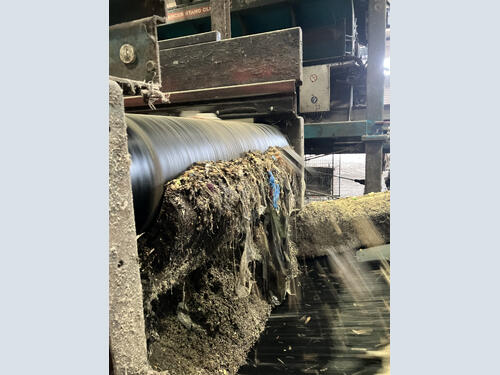
Fugitive material at the discharge zone can also be problematic. Carryback from inadequate belt cleaning can lead to spillage and cause airborne material along the entire length of the belt return.
To prevent carryback, manufacturers of belt cleaners have devised durable solutions capable of cleaning belts from the most abrasive, corrosive, acidic, or liquid substances without damaging the belt. [Fig.6]
CASE STUDY: Energy-from-waste processing – Germany
A major energy-from-waste plant in the Hamburg region of Germany, processes around 300,000 tonnes of waste annually. The facility handles a variety of materials and generates energy in the form of electricity and heat, while also recovery residual materials for reuse. A key part of the operation are its 40 conveyor belts – from 800mm to 1200mm in width and typically running at 1.3 m/s – used to transport abrasive materials through the process. Persistent carryback on most conveyors led to excessive cleaning demands, undermining productivity and creating potential safety risks.
Martin Engineering’s experts visited the site and recommended an innovative belt-cleaning solution, the highly effective CleanScrape® Primary Cleaner and SQC2™ Secondary Cleaner. Both cleaners are perfectly suited for tough conditions where space is limited. They have long service life and deliver effective belt cleaning without risk to the belt or splice. CleanScrape® Primary Cleaner is especially durable and has a unique design. It is installed diagonally across the discharge pulley, forming a three-dimensional curve, and incorporates a matrix of tungsten carbide tips. Applying minimal pressure, it removes hardened material without damaging the belt or splice.
A total of 30 CleanScrape® Primary Cleaners and 5 SQC2™ Secondary Cleaners were installed on the affected conveyors. Thanks to the optimised belt cleaning performance, the plant achieved a higher level of productivity with much less maintenance. The installation significantly reduced the amount of cleaning and unscheduled downtime, which lowered the cost of operation.
Conclusion
While conveyor transfer points are not the only source of dust, they are among the most prevalent generators of particulate emissions. Beyond health and safety, eliminating airborne dust delivers numerous benefits, including better housekeeping, improved environmental management, less maintenance, process efficiency, greater productivity and whole-life cost reduction.